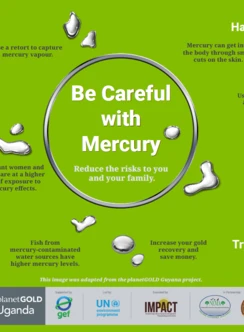
The Be careful with mercury: Reduce the risks to you and your family poster provides simple, practical information on the dangers of mercury exposure and how it can affect miners, their families and communities including pregnant women. It highlights safer practices that can help reduce exposure and protect health.
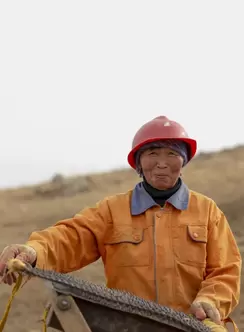
As in many ASM communities across the world, women working in Indonesia’s ASGM sector face many gender-specific challenges. These include unfair allocation of property rights and patriarchal social norms that can disadvantage them in pursuing ownership, education, enabling technologies, and secondary employment opportunities (CIRDI 2020). A case study.
Doris Buss, Blair Rutherford, Jennifer Hinton and Jennifer Stewart (Carleton University);,
Joanne Lebert and Gisèle Eva Côté (Partnership Africa Canada);,
Abby Sebina-Zziwa, Richard Kibombo and Frederick Kisekka (Development Research and Policy Analysis Center),
- Institute for the Study of International Development
English
This paper examines: the structural gender inequalities that impact on access to resources and relationships; gendered social and political institutions that structure ASM livelihoods; and gendered “meaning systems,” the discourses, terms, and metaphors that structure how mining and mining activities, and the women and men whose lives are enmeshed in those activities, are made knowable.
ASGM affects women and men in different ways. Learn about incorporating a gender dimension into activities to support ASGM actors in this collection of resources.
Curated collections include some of the most useful and relevant resources on key ASGM topics, selected by the planetGOLD team. Click here to view all of the collections.
Oscar Katho, Joanne Lebert, Jean Paul Lonema, Patience Singo, and Gerard van der Burg
English
This report summarizes IMPACT's experiences implementing the Just Gold project in DRC from 2012 to 2020 which sought to test whether and how artisanal gold could be traced from mine site to market. The report promotes transparency to assist others committed to supporting security, development, and equality for women and men miners and ASM communities.
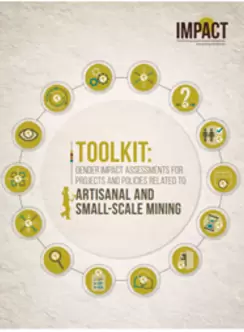
The toolkit was developed as part of IMPACT’s vision for natural resources to benefit all genders equally, over the course of IMPACT’s work in Democratic Republic of Congo and Uganda where the organization, along with its partners, identified gaps in tools available to analyze the impact on women in field-based projects addressing ASM formalization.
This Methodological Brief on Gender defines the approach of the UN-REDD Programme (UN-REDD) on gender equality and women’s empowerment, aiming particularly at the UN-REDD 2016-2020 Strategic Framework. It can also assist partner countries to realize the gender equality provisions contained in international agreements on REDD+, including on safeguards, as well as contribute to Sustainable Development Goal (SDG) #5 on gender equality.
Highlighted in this case study are the results of the “Foundations for Peace in Artisanal Gold Mining in Burkina Faso” project implemented by the NGO IMPACT and the Alliance for Responsible Mining (ARM) from 2021 to 2023. One of the project’s objectives was to strengthen the economic empowerment and financial inclusion of women engaged in ASGM in the target locations. This case study is part of a larger body of work documenting financial access interventions for the ASGM sector.
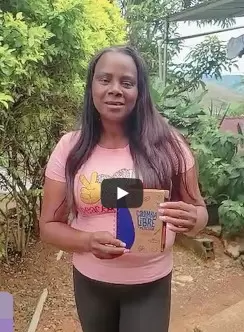
Continue your story for equality! 📘👉 We invited several women to tell us how they recognize themselves and contribute to the empowerment of their actions and territories. 🤗✊ As true protagonists, they narrated their motivations through videos and joined the common message for a more inclusive world, without stereotypes and with equal opportunities. #GeneroMas🎥👇 And you, woman, how do you recognize yourself?
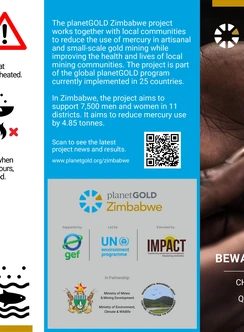
The Beware of Mercury brochure outlines the health effects of mercury on pregnant women, children, the environment, and the community. It also covers the signs and symptoms of mercury poisoning, safe handling practices, and the dangers of exposure. In addition, it briefly explains the work of the planetGOLD Zimbabwe project and how miners and communities can engage with its efforts to build a responsible artisanal and small-scale gold mining sector.


Knowledge areas: