This paper examines the local gender dynamics and division of labour in ASGM from research in Prestea-Huni Valley Municipality, Ghana. Findings show that while men were mainly engaged in the extraction – digging, shoveling and loading of women’s head pans with mineral ore – and processing work at the colluvial mining sites, women were basically working as laborers.
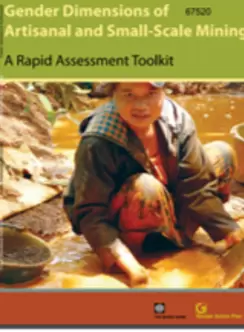
This publication was designed as an easy to-use toolkit for identifying the gender dimensions of artisanal and small-scale mining (ASM). Comprehending this dimension of ASM means understanding how men and women are differentially involved in and affected by ASM, and the factors surrounding their engagement in ASM. By so doing, projects and policies can be put in place to ensure that men and women have equitable opportunities for participation at all stages of the ASM value chain, as well as access to the benefits of ASM, and that neither men nor women disproportionately bear the risks associated with ASM.
This paper explores the gendered contexts of artisanal and small-scale mining in sub-Saharan Africa, and traces how women are likely to be excluded from current policy pushes to formally regulate the sector. Drawing on qualitative and quantitative research results from six artisanal and small-scale mining (ASM) sites, two in each of Democratic Republic of Congo, Rwanda and Uganda, the paper traces how the gendered organization of mining roles, when viewed in relation to women’s disproportionate household and care work, and the gendered norms around what women should do, devalues and delimits women’s mining work. The result, we argue, is that
The artisanal small-scale gold mining activity provides a significant boost in economic activity for rural communities, yet the informal nature of the majority of operations in this sector makes it difficult for miners to access financing and cleaner technologies that could transform their operations. Both women and men are engaged in ASGM in Indonesia. However, GOLD-ISMIA Project has come to understand that there are gender-based differences in the types of work women and men are engaged relating to ASGM, leading to gaps in the income they can earn, disparities in access to knowledge and technologies, and differences in the health risks they
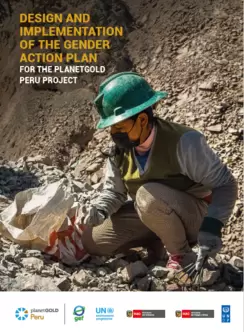
“Design and implementation of the gender action plan of the planetGOLD Peru project” gathers the experience developed by the initiative between 2020 and 2024 to recognize the work of women in small-scale and artisanal mining in Peru. The document summarizes the process from the diagnosis findings, the work with national actors, and the roadmaps followed at the local level with women mining organizations in Arequipa, Piura, and Puno regions in Peru. Also available in Spanish.
This report includes three case studies around the experiences of women in ASM in Zimbabwe, Peru and the Philippines. The document is available in English, French and Spanish.
This paper focuses on women’s roles in Guyana's ASGM sector, with the intention of providing comprehensive findings that can be used to make the sector more gender-inclusive and environmentally and socially sustainable.
Half of the workers in the Congolese artisanal pits are women, and for years they have faced inequality and sexual harassment. Now a grassroots movement aims to change that.
This document summarizes the environmental and occupational health hazards and adverse health outcomes associated with ASGM. Special considerations for women and children are also explored.




Countries: