This training module developed by Women4Biodiversity is designed to guide the gender-responsive implementation of the KM-GBF and the Gender Plan of Action 2022-2030.The module has been designed to accommodate both in-person and online learnings.
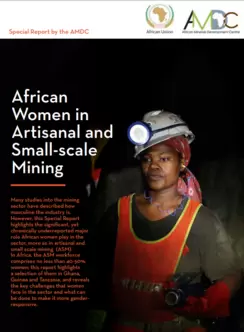
This Special Report highlights the significant, yet chronically underreported major role African women play in the sector, more so in artisanal and small scale mining (ASM). In Africa, the ASM workforce comprises no less than 40-50% women; this report highlights a selection of them in Ghana, Guinea and Tanzania, and reveals the key challenges that women face in the sector and what can be done to make it more gender-responsive
Women’s Rights and Mining is an collaborative effort of NGOs, researchers and government organisations to secure commitments from key stakeholders in the mining sector to address key gender concerns
This handbook is an introduction to the human rights of indigenous women. As an introductory handbook, it does not provide exhaustive information on the various human rights bodies available to indigenous women, but provides some detail on the CEDAW as the only instrument specifically for women. It also provides a brief overview of the other available human rights mechanisms.
Women’s critical role in mineral production and trade - and the unique risks and challenges they face – need to be made visible to support more equitable development gains. Here are 10 strategies to strengthen risk mitigation strategies during OECD Due Diligence Implementation.
This research paper seeks to outline and assess the social, economic, political and cultural barriers that women face thereby, hindering them from fully participating in ASGM in Zimbabwe.
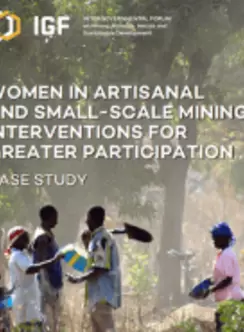
This case study highlights how to improve women’s participation in artisanal and small-scale mining (ASM), complementing the IGF’s previous report, Women in Artisanal and Small-Scale Mining: Challenges and opportunities for greater participation.
In this Q&A, James McQuilken shares his insights on women in ASM and how stakeholders can work together to improve the lives and work of women in the sector.
The paper examines the link between poverty and artisanal and small-scale mining (ASM) in sub-Saharan Africa. It challenges the idea that ASM workers are simply trapped in a poverty cycle, using research on marginalized women in Ghana to add nuance. It argues that discussions should focus on how dependence on mining income, especially for women, can increase vulnerability rather than alleviate poverty.
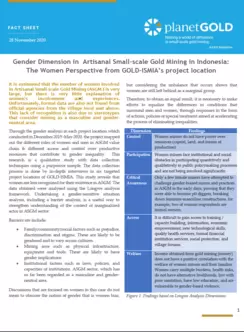
It is estimated that the number of women involved in Artisanal Small-scale Gold Mining (ASGM ) is very large, but there is very little explanation of women's involvement and experiences. Unfortunately, formal data are also not found from official agencies from the village level and above. This lack of recognition is also due to stereotypes that consider mining as a masculine and gender-neutral area.




Knowledge areas: