This paper provides an overview of extant research on gender and women’s livelihoods in artisanal and small-scale mining (ASM), mostly of precious or high-value minerals, and some of the gaps that the papers assembled in this special issue address. This introductory paper also seeks to frame the special issue by questioning the forms of visibility of “women in mining” in policy and scholarly work.
This study aimed to improve the visibility, accessibility, and support for women involved in artisanal and small-scale gold mining (ASGM) in the communities of Sagada, Mountain Province, Cordillera Administrative Region (CAR), and Paracale, Camarines Norte, Bicol Region in the Philippines. Its main objective was to assess the current situation of women in ASGM communities and identify opportunities for collaboration between national and local government agencies to assist these women. The study utilized qualitative and quantitative methods of data collection, including surveys, interviews, focus group discussions (FGDs), key informant
This factsheet provides an overview of the situation of women miners in the Philippines, focusing on gender norms, opportunities, and challenges they encounter. It highlights their roles in the sector, with insights drawn from the baseline study conducted by the Artisanal Gold Council in March 2021.
Women play a crucial role in artisanal and small-scale mining (ASM). While their challenges in the sector have been studied extensively, increased effort is needed to create a more widespread understanding of their importance to ASM.
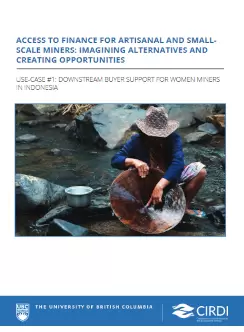
This case study covers the application of a downstream buyer support model to support a collective of women panners called “Pamuan Jaya Panners” in the village. Through facilitated partnerships with the local village government and a socially responsible jewelry company based in Bali, Yayasan Tambuhak Sinta has helped develop access to finance model that continues to support 25 women miners in Tewang Pajangan. This case study will provide local context and existing challenges at the village level, in addition to analyzing the development, implementation, and results of the model. The case study concludes with lessons learned and suggestions
Patricio Colón Velásquez-López, Claudia Páez-Varas, Ximena Benavides-Zúñiga, Francisco Gallegos, Gerald Fallon
English
CIRDI conducted an exploratory study of the nature of women mine-rock waste collectors’ (WWC) activities and analysed their working conditions managing mine waste rock in Ponce Enríquez, Ecuador. A WWC is locally known as janchera, and currently hundreds of women are involved in this activity within artisanal and small-scale gold mining.
This guide is intended to share some of the learnings and best practices in the hope that this will further encourage greater participation and engagement with women at gold mining operations and in the communities that support these operations.
Fitsum Weldegiorgis, Lynda Lawson, Hannelore Verbrugge
English
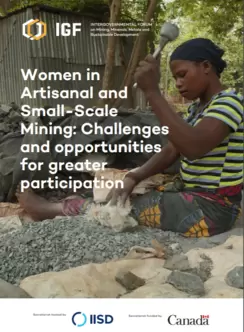
The various challenges women face within this sector have been sporadically highlighted in the literature, and a systematic and in-depth approach to understanding those challenges has been inadequate. With some research limitations, this paper takes a focused approach to understanding the key bottlenecks to women’s full participation with the aim of informing highly sought interventions to address those challenges.
Guidance developed by the Association of Women in Energy & Extractives in Kenya (AWIEK) for response and prevention of sexual and gender based violence for women in mining.
This video tells the story of Anna, a female mine worker in Tanzania. Tanzania is the fourth-largest producer of gold in Africa. In Tanzania, approximately 25 percent of all people directly involved in artisanal and small-scale gold mines (ASGM), are women.


Knowledge areas: