MIT D-Lab and Alliance for Responsible Mining
English
The MIT D-Lab Inclusive Economies program and the Alliance for Responsible Mining in Colombia, joined together to launch a two-year program addressing gender-based violence affecting women engaged in artisanal and small-scale gold mining in the Antioquia region of Colombia.
The project uses an innovative movement-building approach to foster women miners’ associations and homegrown advocacy to address social and economic gender-based violence in mining communities in Andes, Zaragoza, Nechí, and El Bagre in Antioquia, Colombia.
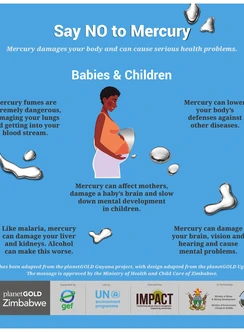
The Say No to Mercury poster provides simple, practical information on the dangers of mercury exposure and how it can affect miners, their families, and communities, including pregnant women and their unborn children.
GII is a composite metric of gender inequality using three dimensions: reproductive health, empowerment and the labour market. A low GII value indicates low inequality between women and men, and vice-versa.
Co-designed with miners, Moyo Gems is an ethical gemstone program being piloted in Tanzania’s gemstone-rich Umba Valley. With the Tanzania Women Miners Association (TAWOMA) and Moyo partners ANZA Gems and Nineteen48, Pact is creating a new ethical gemstone supply chain that is helping women miners in Umba to mine legally, to work more safely, to improve their gem and market skills, to raise their incomes, and to be recognized for the arduous work that makes consumers’ jewelry possible. In this video, meet Moyo miner Fatuma. Learn more at moyogems.com.
Co-designed with miners, Moyo Gems is an ethical gemstone program being piloted in Tanzania’s gemstone-rich Umba Valley. With the Tanzania Women Miners Association (TAWOMA) and Moyo partners ANZA Gems and Nineteen48, Pact is creating a new ethical gemstone supply chain that is helping women miners in Umba to mine legally, to work more safely, to improve their gem and market skills, to raise their incomes, and to be recognized for the arduous work that makes consumers’ jewelry possible. In this video, meet Moyo miner Prisca. Learn more at moyogems.com.
CIRDI’s Gender Equality Strategy lays out our vision of how sustainable natural resource development can generate lasting and inclusive benefits for women, men and children when gender equality is fully integrated.
GOLD-ISMIA Project has come to understand that there are gender-based differences in the types of work women and men are engaged relating to ASGM, leading to gaps in the income they can earn, disparities in access to knowledge and technologies, and differences in the health risks they are exposed to.
This Policy sets out the guiding principles and mandatory requirements for mainstreaming gender across the GEF’s governance and operations with a view to promoting gender equality and the empowerment of women and girls in support of the GEF’s mandate to achieve global environmental benefits. This Policy supersedes the 2011 Gender Mainstreaming Policy
This paper reflects critically on the challenges with reducing women’s exposure to mercury at artisanal and small-scale gold mines in sub-Saharan Africa. It draws on findings from ongoing research in Ghana, the location of one of the largest and most dynamic artisanal and small-scale gold mining sectors in the region.
Gender analysis is the study of the different roles of women and men in order to understand what they do, what resources they have, and what their needs and priorities . GOLD-ISMIA uses gender analysis to address differentiated access to and control over resources and decision making within six ASGM locations


Knowledge areas: