
Addressing Forced Labor in Artisanal and Small Scale Mining (ASM) A Practitioner’s Toolkit
Alliance for Responsible Mining English
Managing the risk of forced labor in ASM is complex. Strategies to tackle it must address the double objective of eradicating forced labor and making sure that innocent people who rely on Artisanal and Small-scale Mining for their livelihoods are not excluded from mineral supply chains. ASM is a poverty-alleviating activity that directly and indirectly employs hundreds of millions of people around the world; excluding ASM from mineral supply chains could have a terrible impact on their livelihoods. The aim of this toolkit is to provide a handson approach that will help organizations, companies and government institutions to cooperate with
Addressing Gender in the Artisanal & Small-Scale Gold Mining Sector
Mona Avalos - planetGOLD EnglishFrenchSpanish
While women are active in the artisanal and small-scale gold mining (ASGM) workforce, they also typically face a range of gender-specific barriers that prevent their full participation. The planetGOLD programme is committed to supporting and creating sustainable opportunities that strengthen gender inclusiveness in ASGM. Country projects take several measures to ensure the active inclusion of women’s voices and concerns in all phases of their projects, from stakeholder engagement (such as project kick-off meetings, trainings, and steering committees) to special gender baseline studies and gender equity planning, to the design of specific
Knowledge areas:
Topics:

Advancing Women's Rights & Gender Equality: Training Module
Women4Biodiversity English
This training module developed by Women4Biodiversity is designed to guide the gender-responsive implementation of the KM-GBF and the Gender Plan of Action 2022-2030.The module has been designed to accommodate both in-person and online learnings.
Knowledge areas:
Topics:
Artisanal and Small-Scale Mining A Rapid Assessment Toolkit to address gender dimension
The World Bank English
This publication was designed as an easy to-use toolkit for identifying the gender dimensions of artisanal and small-scale mining (ASM). Comprehending this dimension of ASM means understanding how men and women are differentially involved in and affected by ASM, and the factors surrounding their engagement in ASM. By so doing, projects and policies can be put in place to ensure that men and women have equitable opportunities for participation at all stages of the ASM value chain, as well as access to the benefits of ASM, and that neither men nor women disproportionately bear the risks associated with ASM.
Topics:
Can large-scale technology raise small-miner income and reduce mercury? Prospects for female waste-rock collectors selling ore to non-mercury processing plants
Danny Tobin OpeDanny Tobin , Alexander Pfaff , Dayron Monroy , Bryan Salgado-Almeida , Adam M. Kiefer and Daniel Garces English
The study focuses on an alternative to the miners processing ore themselves; instead small miners sell their ore to plants employing larger-scale, mercury-free technologies that also raise gold yields. Taking an interesting lens the researchers assessed the ore-selling preferences of female waste-rock collectors (jancheras) in Ecuador, using a discrete-choice experiment.
Gender Action Plan: For the Minamata Convention on Mercury
Secretariat of the Minamata Convention on Mercury English
This gender action plan provides a comprehensive blueprint for actions to promote gender equality, supporting and advancing a gender-responsive implementation of the Minamata Convention.
Gender and Indigenous Peoples : Overview
United Nations Office of the Special Adviser on Gender Issues and Advancement of Women and the Secretariat of the United Nations Permanent Forum on Indigenous Issues English
This briefing note highlights the disproportionate discrimination and human rights abuses Indigenous women face.
Topics:
Gender Dimensions of Artisanal and Small-Scale Mining: A Rapid Assessment Toolkit
The World Bank English
This publication was designed as an easy to-use toolkit for identifying the gender dimensions of artisanal and small-scale mining (ASM).
Topics:
Gender in National Action Plans for Artisanal and Small-Scale Mining: A Quick Start Guide
UNEP English
The Quick Start Guide summarizes and provides a visual overview of the key issues and recommendations for incorporating gender dimension into National Action Plans for artisanal and small scale gold mining. The document is based on the detailed guidance presented in UNEP's Guide on Incorporating Gender Dimensions into National Strategy Setting in the Context of Chemicals Management.
Knowledge areas:
Topics:
Gender Mainstreaming in Projects: Case Studies from the Specific International Programme
Secretariat of the Minamata Convention on Mercury English
This new publication presents an assessment of how projects funded by the Specific International Programme (SIP) under the Minamata Convention integrate considerations related to women and girls in their design and implementation.
Topics:
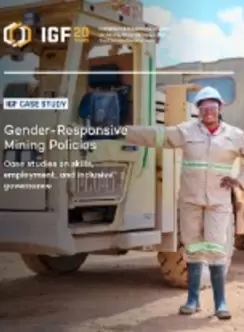
Gender-Responsive Mining Policies: Case studies on skills, employment, and inclusive governance
Lisl Pullinger, Ege Tekinbas, and Elena Cornaro English
This publication presents case studies of instances where mining companies adopted policies and practices to support gender equality and social inclusion. Case studies focus on Chile, the Democratic Republic of the Congo, Mauritania, and South Africa. Each of the following cases is accompanied by an analysis of the relevant regulatory framework enabling good mining practice, as well as key lessons learned.
Knowledge areas:
Topics:
Incorporating gender dimensions into national strategy setting in chemicals management
UNEP English
This joint guidance has been developed to support gender mainstreaming in the development of artisanal and small-scale gold mining National Action Plans (NAPs) in line with Annex C of the Minamata Convention on Mercury, as well as for the development of National Implementation Plans (NIPs) for the management of persistent organic pollutants in line with the Stockholm Convention. The document provides guidance on incorporating gender dimensions throughout the process and into strategic content of both NAPs and NIPs. The Annexes present detailed considerations and tools relevant for both and specific to NAPs and NIPs
Topics:
Toolkit: Gender Impact Assessments for Projects and Policies Related to Artisanal and Small-Scale Mining
Impact English
The toolkit was developed as part of IMPACT’s vision for natural resources to benefit all genders equally, over the course of IMPACT’s work in Democratic Republic of Congo and Uganda where the organization, along with its partners, identified gaps in tools available to analyze the impact on women in field-based projects addressing ASM formalization.
Topics:
Topics: