Secretariat of the Minamata Convention on Mercury
English
This technical background document provides insights on how to engage with Indigenous Peoples and with local communities, inform policy makers to help protect human health and the environment, reduce the environmental damage and human impacts, and strengthen environmental protection and biodiversity conservation in areas where ASGM is prevalent.
Susan Keane, Ludovic Bernaudat, Kenneth J. Davis, Malgorzata Stylo, Nellia Mutemeri, Patience Singo, Pontsho Twala, Itai Mutemeri, Anne Nakafeero, Imelda Dossou Etui
English
This paper presents an overview of new data, derived from Minamata ASGM National Action Plan submissions, that can contribute to refining estimates of mercury use in ASGM, and then assesses technologies that can support the phase out mercury use in ASGM while increasing gold recovery.
The Code of Practices (COP) defines the requirements for establishing responsible business practices throughout the jewellery supply chain, from mine to retail. For information regarding transitioning from the 2019 to the 2024 COP and key differences in the revised version, please visit their frequently asked questions (FAQ page).
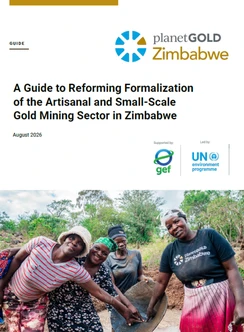
A Guide to Reforming the Formalization of the Artisanal and Small-Scale Gold Mining Sector in Zimbabwe provides a structured roadmap for the transformation of artisanal and small-scale gold mining (ASGM) from a predominantly informal survivalist economy into a regulated, productive, and environmentally responsible sector.
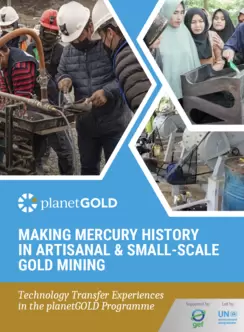
This document provides an overview of the interventions that have been carried out across the planetGOLD programme as of June 2023 to advance responsible mining and eliminate mercury from the ASGM gold supply chain, through technology transfer, technical support, training, and sharing knowledge on best practices in mercury-free gold processing.
Keegan H. Moody; Kazi M. Hasan; Sumeja Aljic; Victoria M. Blakeman; L. Perry Hicks; Danielle C. Loving; Matthew E. Moore; B. Spencer Hammett; Mónica Silva-González; Caryn S. Seney; and Adam M. Kiefer
English
Ratification of the Minamata Convention on Mercury has led to the establishment of Peruvian regulations limiting mercury concentrations in air to 2000 ng/m3 over a 24-hr measurement period. As a result, three communities in Madre de Dios, Peru were mapped during October 2017 to determine Hg0 vapor concentrations in the air.
This report argues that recognition of this diversity of responsible vs. irresponsible operators will be a key first step in allowing the government to develop adequate policies to effectively interact with the sector. The current policy of criminalisation, on the contrary, risks undermining an industry which represents one of the few viable sources of income for the country's impoverished groups.
Edmond N’Bagassi Kohio, Seyram Kossi Sossou , Hela Karoui and Hamma Yacouba
English
ASGM in Burkina Faso increasingly relies on cyanide, intensifying concerns about environmental contamination and human exposure. This study assessed free cyanide levels in water and soil across three ASGM sites—Zougnazagmiline, Guido, and Galgouli.




Topics: