The planetGOLD programme sets out specific criteria to govern the operations of artisanal and small-scale gold mining entities engaged with the programme. The planetGOLD Criteria align with the CRAFT Code, and include three criteria that are specific to the planetGOLD programme: eliminating mercury in the mining process, respecting and protecting the rights of Indigenous Peoples, and minimizing impact on biodiversity. Conformance with this criteria will ensure that artisanal and small-scale miners participating in the planetGOLD programme undertake sufficient efforts to avoid, minimize, mitigate, and where appropriate, offset adverse impacts
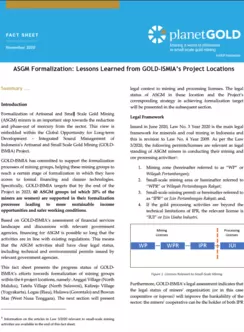
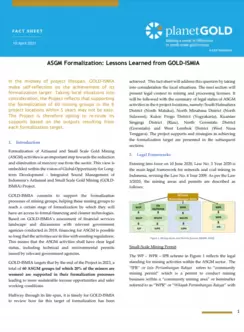
Formalization of Artisanal and Small Scale Gold Mining (ASGM) miners is an important step towards the reduction and phase-out of mercury from the sector. This view is embedded within the Global Opportunity for Long-term Development – Integrated Sound Management of Indonesia’s Artisanal and Small Scale Gold Mining (GOLD-ISMIA) Project.
Midway through its project lifespan, the planetGOLD project in Indonesia reflects on the achievement of its formalization target. Taking local situations into consideration, the project reflects that supporting the formalization of 60 mining groups in the 6 project locations within 5 years may not be easy. The project is therefore opting to re-route its supports based on the outputs resulting from each formalization target.
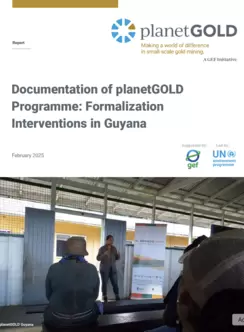
Formalization—the process of integrating ASGM into the formal economy, society, and regulatory system—is a critical step toward helping address environmental and social challenges in the artisanal and small-scale gold mining (ASGM) sector and and toward achieving the sector’s development potential. This report assesses the formalization-related interventions of the planetGOLD Guyana project.
The research analyzes the barriers and limitations of this sector in the regions with the highest incidence or presence of small-scale mining in order to propose financial products and services ad hoc to the reality of ASM that allows them to be included in the formal financial system.
National Program for the Management of Hazardous Chemical Substances
English
Part of "Development of a financial product to be used in the Artisanal and Small Scale Gold Mining Sector" developed by Ecuador's National Program for Environmentally Sound Management and Life-cycle Management of Chemicals.
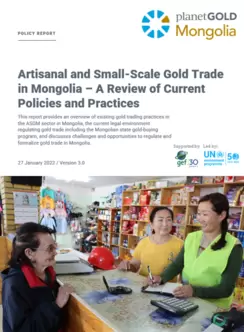
This report provides an overview of existing gold trading practices in the ASGM sector in Mongolia, the current legal environment regulating gold trade including the Mongolian state gold-buying program, and discusses challenges and opportunities to regulate and formalize gold trade in Mongolia.
The international workshop "Successful Experiences in Responsible ASGM" was held between January 11 and 15, 2021, more than 30 mining organizations and international public and private institutions in Bolivia, Ecuador, Colombia, Indonesia, Honduras, and Peru shared their successful experiences in adopting clean technologies, as well as implementing best practices in ASGM.
Under Component 1, the Global Opportunities for Long-Term Development – Integrated Sound Management of Mercury in Indonesia’s Artisanal and Small-Scale Gold Mining (GOLD-ISMIA) Project aims to establish national systems whose capacity to assess, plan and implement sustainable and mercury-free interventions in the ASGM sector. The Project also aims to create enabling environment through improved national policies and regulatory frameworks for ASGM and mercury phase-out in the sector.
The potential gold reserves at Boliyohuto Mountain (2,065m), located in Hulawa Vilage, Sumalata Timur District, North Gorontalo Regency has attracted legal and illegal mining attention for over 150 years. Local miners first exploited the resource in 1865 and then in 1885 the Bauermann family from the Netherlands began mining operations. In 1896, a mining permit was granted by the Dutch Government to NV. Mijnbouw Maatschappij “Soemalata”.





Topics: