This technical brief highlights the integration of holistic livelihoods interventions into an overall approach aiming to reduce the number of children working in the mines while empowering households and making them more economically resilient.
Artisanal Gold Council and Asia Pacific Economic Cooperation
English
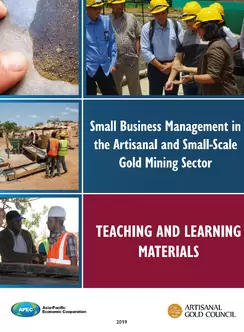
This curriculum was developed as part of the project Developing Training Materials to Promote the Reduction of Mercury Use in Artisanal and Small-scale Gold Mining. This curriculum is intended to help teach fundamental business skills to artisanal and small-scale gold miners. These teaching and learning materials are designed to be “open source” meaning that they are made available freely for use by programs, organizations and institutions of all kinds working in the artisanal and small-scale gold mining sector.
Gregory Minnick, Peter Doyle, and Thomas Hentschel
English
This study included a consultative process with a broad array of stakeholder groups yielding consensus on the principal obstacles to ASGM formalization. To enable ASGM operators to formalize, a recommendation emerged for a National Unified Formalization Plan, which rests on six proposals that largely align with current policy and legislation.
Vivian W. L. Tsang; Karen Lockhart; Samuel J. Spiegel; and Annalee Yassi
English
This systematic review, conducted as part of the World Health Organization’s Global Plan of Action for Workers’ Health, sought to assess the state of knowledge on occupational health programs and interventions for the informal ASGM sector.
Leonardo Barcellos de Bakker, Pedro Gasparinetti, Júlia Mello de Queiroz, and Ana Claudia Santiago de Vasconcellos
English
The main objective of this study is to propose a methodology to evaluate the impacts of ASGM on human health in different contexts in the Brazilian Amazon. It connects several points in the literature based on hypotheses regarding mercury dispersion in water, its transformation into methylmercury, and absorption by fish and humans. This methodology can be used as a tool to estimate the extent of environmental damage caused by artisanal gold mining, the severity of damage to the health of individuals contaminated by mercury and, consequently, can contribute to the application of fines to environmental violators.
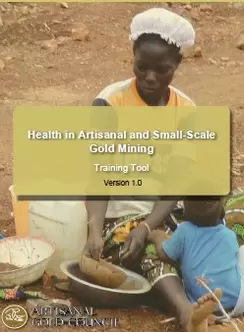
This document was created to support health workers who practice in communities where ASGM occurs. This guide is illustrated and contains key messages that should be conveyed to the community. This guide can be used for group information sessions or for individual sessions.
The Tapajos River Basin in the Brazilian Amazon is the location of one of the largest concentrations of artisanal and small-scale miners in the world. A group of educators provided support to miners, training 4200 people in 141 mining locations. The effectiveness of this training was evaluated based on 20 performance indicators. After 120 days of training, an absolute improvement of approximately 29% had been achieved.




Knowledge areas: