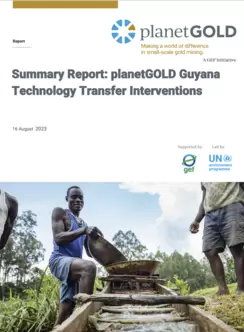
This document provides an overview of the interventions that have been carried out across the planetGOLD programme as of June 2023 to advance responsible mining and eliminate mercury from the ASGM gold supply chain, through technology transfer, technical support, training, and sharing knowledge on best practices in mercury-free gold processing.
Keegan H. Moody; Kazi M. Hasan; Sumeja Aljic; Victoria M. Blakeman; L. Perry Hicks; Danielle C. Loving; Matthew E. Moore; B. Spencer Hammett; Mónica Silva-González; Caryn S. Seney; and Adam M. Kiefer
English
Ratification of the Minamata Convention on Mercury has led to the establishment of Peruvian regulations limiting mercury concentrations in air to 2000 ng/m3 over a 24-hr measurement period. As a result, three communities in Madre de Dios, Peru were mapped during October 2017 to determine Hg0 vapor concentrations in the air.
This report argues that recognition of this diversity of responsible vs. irresponsible operators will be a key first step in allowing the government to develop adequate policies to effectively interact with the sector. The current policy of criminalisation, on the contrary, risks undermining an industry which represents one of the few viable sources of income for the country's impoverished groups.
Edmond N’Bagassi Kohio, Seyram Kossi Sossou , Hela Karoui and Hamma Yacouba
English
ASGM in Burkina Faso increasingly relies on cyanide, intensifying concerns about environmental contamination and human exposure. This study assessed free cyanide levels in water and soil across three ASGM sites—Zougnazagmiline, Guido, and Galgouli.
The planetGOLD programme sets out specific criteria to govern the operations of artisanal and small-scale gold mining entities engaged with the programme. The planetGOLD Criteria align with the CRAFT Code, and include three criteria that are specific to the planetGOLD programme: eliminating mercury in the mining process, respecting and protecting the rights of Indigenous Peoples, and minimizing impact on biodiversity. Conformance with this criteria will ensure that artisanal and small-scale miners participating in the planetGOLD programme undertake sufficient efforts to avoid, minimize, mitigate, and where appropriate, offset adverse impacts
Midway through its project lifespan, the planetGOLD project in Indonesia reflects on the achievement of its formalization target. Taking local situations into consideration, the project reflects that supporting the formalization of 60 mining groups in the 6 project locations within 5 years may not be easy. The project is therefore opting to re-route its supports based on the outputs resulting from each formalization target.
Formalization of Artisanal and Small Scale Gold Mining (ASGM) miners is an important step towards the reduction and phase-out of mercury from the sector. This view is embedded within the Global Opportunity for Long-term Development – Integrated Sound Management of Indonesia’s Artisanal and Small Scale Gold Mining (GOLD-ISMIA) Project.
Formalization—the process of integrating ASGM into the formal economy, society, and regulatory system—is a critical step toward helping address environmental and social challenges in the artisanal and small-scale gold mining (ASGM) sector and and toward achieving the sector’s development potential. This report assesses the formalization-related interventions of the planetGOLD Guyana project.
The research analyzes the barriers and limitations of this sector in the regions with the highest incidence or presence of small-scale mining in order to propose financial products and services ad hoc to the reality of ASM that allows them to be included in the formal financial system.
Knowledge areas: