National Environment Management Authority (NEMA) - Uganda
English
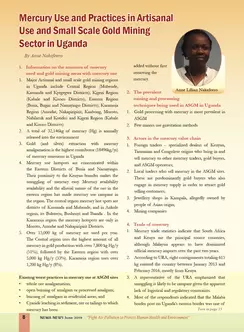
In this 2019 edition of the NEMA newsletter, Anne Nakafeero authors an article beginning on page 8 detailing key facts and figures on the ASGM sector in Uganda
This paper provides an opportunity to study the drivers of ASM’s exposure to capture by criminal and armed actors, the consequences of acting on the wrong assumptions or failing to act at all, and the shared responsibility to ensure that rising demand for gold does not deepen conflict but instead supports more just outcomes.
Danny Tobin OpeDanny Tobin , Alexander Pfaff , Dayron Monroy , Bryan Salgado-Almeida , Adam M. Kiefer and Daniel Garces
English
The study focuses on an alternative to the miners processing ore themselves; instead small miners sell their ore to plants employing larger-scale, mercury-free technologies that also raise gold yields. Taking an interesting lens the researchers assessed the ore-selling preferences of female waste-rock collectors (jancheras) in Ecuador, using a discrete-choice experiment.
The Amazon is under assault from organised crime. Exploiting weak governance, illegal groups are pushing deep into protected jungle areas as they seek out new routes for drug trafficking and sites to extract gold and critical minerals. The Portuguese and Spanish versions can be found here.
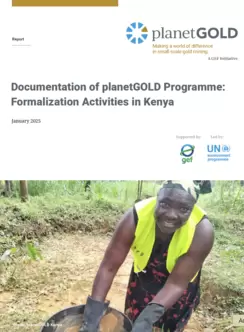
Formalization—the process of integrating ASGM into the formal economy, society, and regulatory system—is a critical step toward helping address environmental and social challenges in the artisanal and small-scale gold mining (ASGM) sector and and toward achieving the sector’s development potential. This report assesses the formalization-related interventions of the planetGOLD Kenya project.
This paper highlights the role that OECD-led initiatives to support ASM formalisation in conflict zones can play to support disarmament, demobilisation and reintegration programmes.
United Nations Environment Programme ,
Minamata Convention on Mercury
English
This report was developed in response to decision MC-4/4 by the Conference of the Parties to the Minamata Convention on Mercury, at its fourth meeting, where it requested the Secretariat “to compile views on the needs and priorities of indigenous peoples and local communities with regard to the use of mercury in artisanal and small-scale gold mining”.
Tehtena Mebratu-Tsegaye, Senior Legal Researcher, Columbia Center on Sustainable Investment,
Leila Kazemi, Ph.D., Extractives Governance Expert and Project Lead for the Executive Session on the Politics of Extractive Industries
English
The authors of this report looked at the politics of FPIC in Latin America, analyzing how the power and interests of the key players–across governments, companies and indigenous peoples–can determine the fate of FPIC and consultation processes in practice. This research focused on Brazil, Colombia, and Peru, and provides practical options to address key political challenges in hopes of improving outcomes for indigenous and tribal peoples.
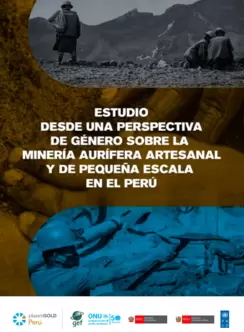
El estudio analiza la situación de los hombres y las mujeres que trabajan en la Minería Artesanal y de Pequeña Escala (MAPE) de oro en el Perú, bajo tres perfiles: hombres y mujeres en la MAPE -socios/as, cargos directivos, consultores/as, trabajadores/as dentro de la operación minera- y mujeres seleccionadoras de mineral -más conocidas como “pallaqueras”.




Countries: