This research provides insights into the opportunities presented by technology as well as the pre-conditions and enabling environment required for technology to contribute effectively to responsible minerals production and sourcing. The report also addresses some limitations, emphasising the role of pre-existing processes, behaviours and stakeholder engagement in responsible minerals production and sourcing.
This report describes and evaluates initiatives to formalise the artisanal mining sector in the Democratic Republic of the Congo (DRC) and Rwanda, in order to locate lessons learned.
Despite producing an estimated 20% of the world’s annual supply of newly mined gold, the ASGM sector has traditionally had challenges connecting with the formal world gold market. While numerous formal buyers are eager for gold produced by artisanal and small-scale gold miners, meeting rigorous standards for due diligence standards and responsible sourcing poses a challenge. This study examines the role that can be played by supply chain technologies in facilitating conformity with the planetGOLD Criteria by looking at specific types of supply chain solutions, including due diligence, traceability and block-chain solutions, and analyzing
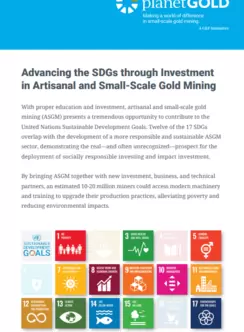
With proper education and investment, artisanal and small-scale gold mining presents a tremendous opportunity to contribute to the United Nations Sustainable Development Goals. Learn how 12 of the 17 SDGs overlap with the development of a more responsible and sustainable ASGM sector, demonstrating the real—and often unrecognized—prospect for the deployment of socially responsible investing and impact investment.
This fact sheet provides an overview of Pact's work on artisanal and small-scale gold mining, including the organization's approach to professionalizing the sector and current and previous projects.
TheplanetGOLD Mongolia project is working towards the formalization and professionalization of artisanal and small-scale gold mining (ASGM) sector in Mongolia, including the elimination of mercury use in gold processing. The team is working with various stakeholders along the gold supply chain – miners, gold traders, local and national governments as well as civil society – to sustainably improve artisanal mining operations as an important economic opportunity for remote communities and to support the revision of regulations governing the sector. In partnership with the national government, the
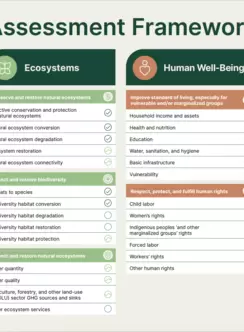
This brochure gives an overview of LandScale, a user-friendly assessment tool and validation service that helps generate credible landscape-level insights.
Dr. Linda Forst, presents approaches and tools trainers of OSH in ASGM, might implement in the field. The recording of the webinar can be found here: OSH in ASGM




Knowledge areas: