Batista, M.J., Carvalho, J., Tychsen, J.
Portuguese
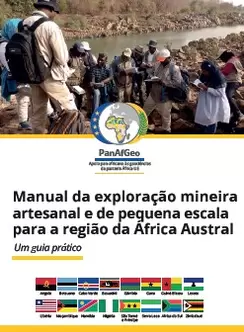
Este guia prático sobre “Exploração Mineira Artesanal e de Pequena Escala na Região da Africa Austral” é o resultado de uma sessão de formação que teve lugar em Maputo, Moçambique de 26 a 30 de Setembro de 2022, como parte do Work Package C sobre Exploração Mineira Artesanal e de Pequena Escala com participantes de 16 países da região Austral de África.
Intergovernmental Forum on Mining, Minerals, Metals and Sustainable Development
English
This report examines the potential for ASM to take an expanded role in meeting critical mineral demand driven by the adoption of low-carbon energy and digital technology.
The report examines the relationship between national fiscal regimes and the formality of the artisanal and small-scale gold mining (ASGM) sector. Specifically, the study attempts to determine whether and to what extent a country’s fiscal regime – the total of taxes, fees, and royalties – acts as significant factor pushing ASGM producers and exporters into informality. The report addresses the production segment of the gold supply chain from the commercialisation segment and focusses specifically on nine planetGOLD countries: Burkina Faso, Colombia, Ecuador, Guyana, Indonesia, Kenya, Mongolia, the Philippines, and Peru.
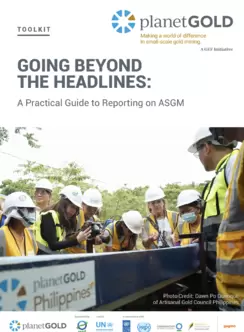
This toolkit was developed as part of a workshop organized by the planetGOLD programme, bringing together journalists from diverse regions to explore solutions-based storytelling in the context of Artisanal and Small-Scale Gold Mining (ASGM). The toolkit provides a comprehensive guide to understanding ASGM and applying solutions journalism principles to create impactful narratives about this complex sector.
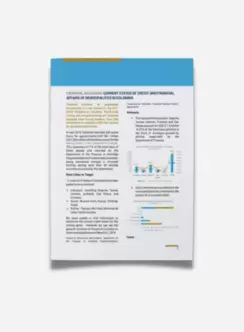
Financial inclusion for sustainable investments is a key element in the GEF-GOLD initiative in Colombia. Small-scale mining and artisanal mining are foremost excluded from Formal Banking. Very little information is available within the country for granting credit criteria.
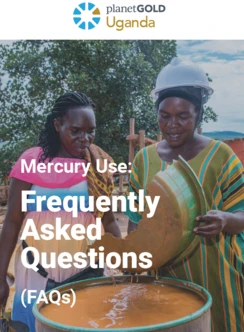
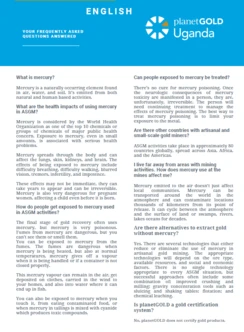
The Frequently asked questions on mercury provides simple and clear information on mercury, its risks to people and the environment in a question-and-answer format. It also explains briefly the work of the planetGOLD Uganda project, and how miners and communities can relate to its work towards a responsible artisanal & small-scale gold mining sector.
The Frequently asked questions on mercury flyer provides simple and clear information on mercury, its risks to people and the environment in a question-and-answer format. It also explains briefly the work of the planetGOLD Uganda project, and how miners and communities can relate to its work towards a responsible artisanal & small-scale gold mining sector.
Franco Arista, National Coordinator of planetGOLD in Peru
English
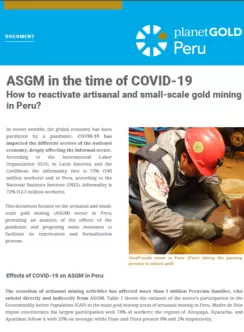
This document produced by the planetGOLD project in Peru puts a focus on the artisanal and small-scale gold mining (ASGM) sector in the country in light of the global COVID-19 outbreak, providing an analysis of the effects of the pandemic and proposing some possible measures to facilitate its reactivation and formalization process.




Knowledge areas: