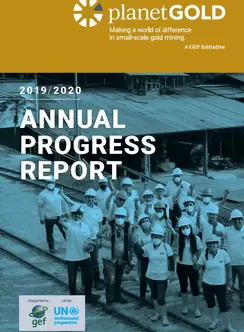
Recognizing that lasting change requires addressing root economic and social drivers of mercury use, planetGOLD is working to accelerate formalization, increase access to formal finance and open avenues to formal gold markets, creating the enabling conditions for the uptake of more efficient, mercury-free technology. This report provides an overview of the progress made since the launch of the planetGOLD programme in early 2019 and includes data from the initiation of each of the national projects through fall 2020.
Despite considerable ongoing challenges presented by the COVID-19 pandemic, the planetGOLD programme has nonetheless managed to advance toward its goals of helping small-scale gold miners avoid the use of mercury, as well as contributing to the creation of more sustainable livelihoods and creating a healthier and more profitable sector overall. This report provides an overview of the progress made by the planetGOLD programme from July 2020 through June 2021.
The purpose of the Guidelines is to assist the United Nations system to mainstream and integrate indigenous peoples’ issues in processes for operational activities and programmes at the country level.
David Sturmes-Verbeek and Candice Jumwa, The Impact Facility; Cristian Arias and Kamila Gómez, Alliance for Responsible Mining
EnglishFrenchSpanish
The comparative analysis detailed in this document draws learnings from efforts undertaken by nine planetGOLD countries participating in the first phase of the programme, by highlighting similarities and differences between different geographic and regulatory environments. This analysis available in English, French and Spanish draws on detailed case studies of these phase one countries' experiences.
In addition to this report, the nine planetGOLD country case studies plus additional materials analyzing access to finance interventions for the ASGM sector can be found on this resource page.
Abby Efua Hilson; Gavin Hilson - for planetGOLD
EnglishFrenchSpanish
This report reviews past experiences with delivering financial and allied services to artisanal and small-scale mining and makes recommendations regarding best practices and potential ways forward in improving access to finance based on this experience.
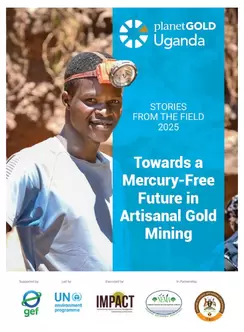
The second edition of Stories from the Field, highlights planetGOLD Uganda's ongoing commitment to advancing a mercury-free artisanal and small-scale gold mining sector. This edition shows the experiences of miners who have embraced mercury-free technologies at their sites, sharing their personal journeys, challenges, and successes. It also offers clear and practical technical insights into the alternative methods miners can adopt as part of the transition to safer, cleaner, and more responsible gold mining practices.
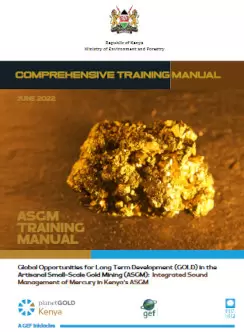
The curriculum has been designed as an introductory level course on basic knowledge, skills and attitudes that will enable artisanal and small-scale miners to run more sustainable, responsible, and profitable enterprises with focus on key safety and health concerns.
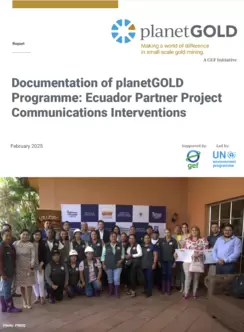
This report assesses the communication and awareness raising related interventions of the National Programme for Chemical Management, planetGOLD's partner project in Ecuador executed from 2018-2024. Strategic, inclusive communication and awareness raising practices play a critical role in educating miners and communities with artisanal and small-scale mining activities, while also helping build greater public support for transforming the ASGM sector with responsible, mercury-free mining practices.
Highlighted in this case study are the results of a financial inclusion program for Tanzania's artisanal and small-scale mining sector begun in 2021 by The Foundation of ASM Development (FADev) in collaboration with SWISSAID Tanzania and the National Bank of Commerce (NBC). The program developed two pilot finance mechanisms in an effort to address critical challenges faced by ASM operators. This case study is part of a larger body of work documenting financial access interventions for the ASGM sector.
This report showcases data contributions made to Delve and demonstrates the potential for a deeper sector analysis when stakeholders share data. As the inaugural report of a planned annual series, the 2019 edition explores the origins and impact of what is identified as the ‘global data gap’ on artisanal and small-scale mining (ASM). It outlines how through collaboration, the gap can be addressed to guide more effective ASM formalization efforts across the globe. Future reports will examine emerging themes of critical importance to ASM.



Knowledge areas: