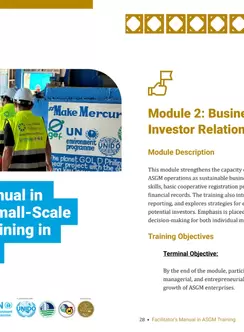
This module strengthens the capacity of miners and cooperative leaders to run ASGM operations as sustainable businesses. Participants will learn entrepreneurial skills, basic cooperative registration procedures, and how to prepare and manage financial records. The training also introduces tools for financial planning and reporting, and explores strategies for engaging with financial institutions and potential investors. Emphasis is placed on transparency, accountability, and sound decision-making for both individual miners and mining cooperatives.
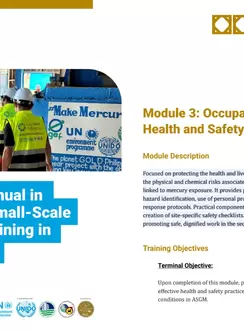
Focused on protecting the health and lives of ASGM workers, this module addresses the physical and chemical risks associated with small-scale mining, especially those linked to mercury exposure. It provides participants with knowledge and skills in hazard identification, use of personal protective equipment (PPE), and emergency response protocols. Practical components include basic mine rescue drills and the creation of site-specific safety checklists. The module supports MGB’s commitment to promoting safe, dignified work in the sector.
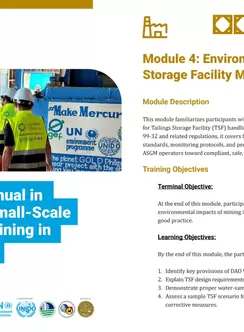
This module familiarizes participants with the legal requirements and best practices for Tailings Storage Facility (TSF) handling in Philippine ASGM. Grounded in DAO99-32 and related regulations, it covers facility siting, design parameters, effluent standards, monitoring protocols, and permit obligations—enabling trainers to guide ASGM operators toward compliant, safe, and sustainable tailings management
This toolkit helps companies avoid impacting negatively on communities and to leave a positive legacy. This document is available in English and Spanish.
Yves Bertran Alvarez; Alliance for Responsible Mining - for planetGOLD
EnglishFrenchSpanish
This report summarizes and analyzes gaps in the available educational and training material from projects and initiatives dealing with occupational safety and health (OSH) in the artisanal and small-scale mining (ASGM) sector. The review focused on cataloguing the various technical aspects of occupational safety and health that are covered by the materials, but also examined the presentation of strategies and methodologies to manage hazard exposure, communication and awareness raising.
The report is available to download in English, French and Spanish.
Three additional related materials on occupational safety and health and ASGM are included
Amarjargal Dairii,
Lkhagvadulam Jamiyandagva,
Khishigsuren Lkhagva,
Altanbagana Bayarsaikhan
English
This report offers a comprehensive overview of the access of artisanal gold miners to key social services in Mongolia, including healthcare, health insurance, social insurance, social welfare, and early childhood education.
These guidelines are based on completed FPIC CI case studies and provide a complementary tool to CI’s institutional policies, including the recently updated Indigenous Peoples and CI Policy. They provide introductory and background information on FPIC, as well as actual steps for ensuring FPIC.
This briefing proposes a collaborative, multi-stakeholder response that is underpinned by a deep understanding of structural inequalities to transform gender relations and design programmes and policies to tackle and prevent GBV within mining workplaces and communities.
Yves Bertran Alvarez; Josephine Singo; Alliance for Responsible Mining - for planetGOLD
EnglishFrenchSpanish
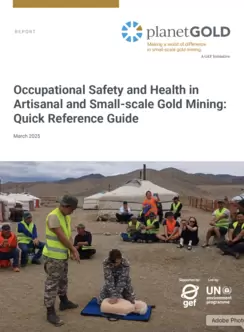
This guide focuses on occupational safety and health (OSH) issues related to artisanal and small-scale mining, with an emphasis on gold mining. Addressing OSH risks improves worker well-being, enhances productivity, and encourages responsible mining practices. However, challenges such as insufficient data, lack of infrastructure, and the need for gender-responsive interventions, mean that OSH measures are usually not fully implemented in the artisanal and small-scale gold mining (ASGM) sector.
This quick reference guide is intended for managers of projects working with mine operations, as well as mine operators themselves, who want to improve






Countries: