Cristian Arias and Kamila Gómez, Alliance for Responsible Mining
English
This case study documents the finance models implemented by the planetGOLD Peru project in artisanal and small-scale gold mining (ASGM) communities, with a consideration of the gender aspects of the projects.
The planetGOLD partner project implemented in Ecuador from 2018 to 2024 undertook targeted initiatives to advance formalization within Ecuador's artisanal and small-scale gold mining (ASGM) sector. The project's efforts towards formalization concentrated on four primary interventions, which are detailed in this report.
Strategic, inclusive communication and awareness raising practices play a critical role in educating miners and communities with artisanal and small-scale mining activities, while also helping build greater public support for transforming the ASGM sector with responsible, mercury-free mining practices. For these reasons, communication is a cross-cutting theme across the planetGOLD programme. This report assesses the communication and awareness raising related interventions of the planetGOLD Philippines project.
Initiative for Responsible Mining Assurance
English
The IRMA Guidance Document to the IRMA Standard for Responsible Mining V1.0 has been updated. This latest version (V1.3), is available in English, and can be found under the Resources webpage.
Battelle and The Cadmus Group, Inc.,
USAID
English
These guidelines are designed for project managers, project implementers, practitioners, or others working on development or environmental management projects that could impact ASM projects or communities that engage in ASM. This document addresses: (1) impact of development projects on ASM; (2) impacts of ASM on the environment, health, and socio-political systems; (3) best practices on mitigation measures for minimizing impacts of ASM; (4) impact of climate change on ASM; and (5) impact of ASM on climate change.
A methodology developed by the IUCN to help implement a gender-responsive analysis for a wide range of partner institutions. Key questions are provided to uncover gender gaps and issues at local, institutional and national levels, as well as gendered differences in the distribution of benefits, risks and opportunities.
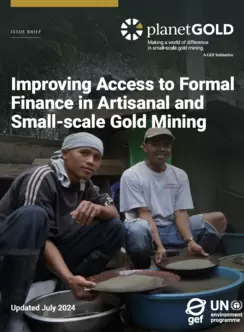
This issue brief originally published in 2020 and updated in 2024 reviews past experiences with delivering financial and allied services to the artisanal and small-scale gold mining (ASGM) sector and examines existing barriers to attracting formal finance and investment in the sector. It concludes with recommended interventions for governments, donors and other allies to help improve ASGM’s access to formal finance in the future.
The Social and Environmental Standards (SES) are an integral component of UNDP’s quality assurance and risk management approach to programming. This publication came into effect on 1 Jan 2021 and is a revised version of the 2015 publication. The French and Spanish versions can be found here.
Jara Bakx, Blanca Racionero Gómez, and Rosanna Tufo - Levin Sources
EnglishFrenchSpanish
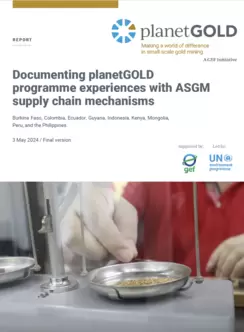
Artisanal and small-scale gold mining's predominantly informal nature, regulatory constraints, financial limitations, and difficulties in meeting compliance standards all present challenges for miners to access formal markets. This report assesses the efficacy of planetGOLD ASGM supply chain mechanisms — focusing on experiences from country projects funded during the program's first phase, with the objective of distilling key insights for similar ASGM market access initiatives.
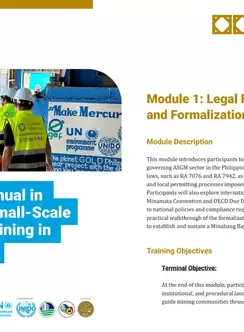
This module introduces participants to the legal and institutional framework governing ASGM sector in the Philippines. It covers the salient features of national laws, such as RA 7076 and RA 7942, as well as relevant administrative orders and local permitting processes imposed by local government units (LGUs).Participants will also explore international standards and conventions like the Minamata Convention and OECD Due Diligence Guidelines and how they relate to national policies and compliance requirements. The session concludes with a practical walkthrough of the formalization process, focusing on the steps needed to establish and sustain



Knowledge areas: