Responsible Mining Foundation and the Columbia Center on Sustainable Investment
English
With just ten years left to achieve the Sustainable Development Goals by the target date of 2030 and four years after the publication of the 2016 Mapping Mining to the Sustainable Development Goals: An Atlas, this report provides a status update of what large-scale mining companies are currently doing to integrate the SDGs into their business strategies and to take proactive measures that will help deliver these Goals.
Set up as a small qualitative scoping study, this IPIS Insight aims to highlight key elements of the socio-economic impact of Covid-19 measures and restrictions on artisanal mining communities in northern Tanzania, as observed by selected members of these mining communities.
y Lucy Atim, Mesiya Mwangoka, Dr. Laura Martins (Montrose International) and Sophie Rickard (Independent Consultant)
English
This study offers a thorough review of the evidence around Sexual and Gender-Based Violence (SGBV) in the mining sector in Sub-Saharan Africa, with a particular focus on the Democratic Republic of Congo (DRC), South Africa, Tanzania and Uganda.
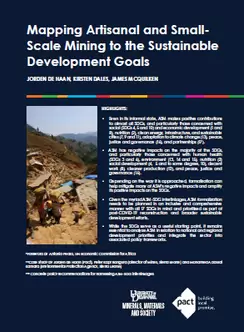
This report analyzes the relationships between ASM and each of the 17 SDGs and their associated targets, and provides concrete guidance to policymakers, donors and private partners for harnessing ASM-SDG interlinkages and unlocking the sector’s full sustainable development potential.
Este reporte analiza los casos de contagios del COVID-19 y su evolución, entre los meses de junio y julio del 2020, correlacionando la información con zonas de pequeña minería y minería artesanal (MAPE) con el propósito de brindar información a las autoridades y líderes mineros para que adopten mecanismos de prevención ante la propagación potencial del virus en las comunidades mineras.
This market analysis is the result of the research phase of the USAID-funded Commercially Viable Conflict-Free Gold (CVCFG) Project, when Levin Sources interviewed manufacturers, refiners and jewellers to understand the dynamics of this complex environment much better.
The study is intended to provide a systematic, evidence-based set of data-points that can inform a more comprehensive policy review process that positively facilitates sustainable and responsible ASM formalisation over the long term.
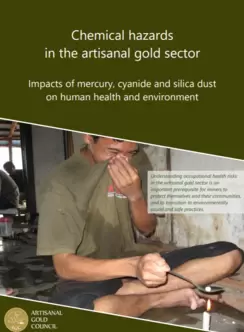
This brochure provides a brief overview on the health and environmental impacts of mercury, cyanide and silica dust in the sector. Chemical risks do not only affect miners, but also their communities. Mercury and cyanide are both highly toxic to human health. However, only mercury persists in the environment and can travel long distances in the environment. Exposure to very fine silica dust is a common hazard in hard rock mining, but one that can easily be prevented
BetterChain implements the Consolidated Autonomous Due Diligence (CADD) framework. It builds the capacity of local stakeholders to collect, compile and report information so that it directly contributes to international due diligence compliance and monitoring activities.



Knowledge areas: