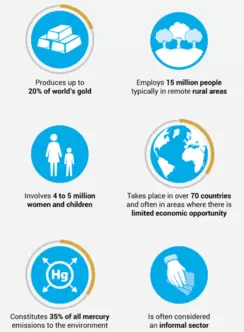
This infographic features a visual summary of the key facts and figures about ASGM. It provides answers to questions such as: Why is it hard to formalize the sector; Why is mercury used in ASGM; How does the Minamata Convention safeguard the ASGM sector? Key strategies through which the planetGOLD programme is transforming the sector are also presented.
This site contains multiple information documents on the dangerous effects of mercury such as: health impacts, tools for actions, guidance documents, fact sheet and other educational materials.
The Technical Background Report to the Global Mercury Assessment 2018 was produced by an international team of experts convened through a collaboration between UN Environment and the Arctic Monitoring and Assessment Programme (AMAP). World Health Organization experts contributed to sections dealing with mercury exposure in humans.
United Nations Environment Program,
Global Mercury Partnership
Arabic
This document represents an expansion of the UNEP Guidance Document: Developing a National Strategic Plan to Reduce Mercury Use in Artisanal and Small-Scale Gold Mining (UNEP 2011), and is intended to reflect advances in understanding of the ASGM sector. Although this guidance document is not legally binding and is not to be construed as a further elaboration or official interpretation of the Minamata Convention, it is intended to provide guidance to countries in formulating NAPs that are consistent with the requirements of the Minamata Convention, and provide technical, legal and policy information on issues related to ASGM.
This report showcases data contributions made to Delve and demonstrates the potential for a deeper sector analysis when stakeholders share data. As the inaugural report of a planned annual series, the 2019 edition explores the origins and impact of what is identified as the ‘global data gap’ on artisanal and small-scale mining (ASM). It outlines how through collaboration, the gap can be addressed to guide more effective ASM formalization efforts across the globe. Future reports will examine emerging themes of critical importance to ASM.
This report documents the use of child labor in artisanal and small-scale mines in Ghana’s Western, Central, and
Ashanti Regions, focusing on unlicensed sites, which constitute the vast majority of mines. It also analyzes the measures that some gold traders and refiners take to avoid supporting child labor by buying gold mined with child labor.
The report discusses the challenges and solution encountered by countries developing National Action Plan for artisanal and small-scale gold mining (ASGM).
A good understanding of mercury supply, trade and demand is critical to effective implementation of the Convention. This report provides detailed and timely information on where mercury comes from, how it moves in commerce, and how it is used in products and industrial processes.
This manual provides training strategies for people teaching artisanal miners and their families both health-related and technical information and skills. This includes peer-educators, technical experts with little or no teaching experience, as well as those accustomed to teaching in academic settings.



Knowledge areas: