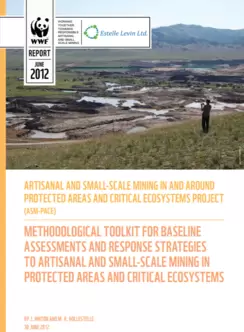
The aim of ASM-PACE is to address the environmental impacts of artisanal and small scale mining (ASM) whilst building on its economic, social, and empowerment potential in some of the world’s most important ecosystems. The Programme uses a scientific foundation of knowledge, participatory methods and rights-based approaches to work with miners and their communities – rather than in opposition – to design sustainable, win-win solutions that will last.
Prepared for Estelle Levin, Ltd and the ASM-PACE project.
This paper provides background research on ASM in Ghana to inform the dialogue — giving an overview of the sector, identifying the barriers to formalisation, and offering some actionable ‘ways forward’.
Prepared for the International Institute for Environment and Development (IIED).
This Policy Brief presents the results of a Knowledge, Attitudes and Practices (KAP) study on mercury use among small-scale gold miners in Suriname, commissioned by GOMIAM and WWF Guianas. Its primary objective is to give an insight into the knowledge, attitudes and practices of miners with regards to the use of mercury in mining. This information is important when it comes to designing policies that have a lasting effect on the reduction and finally the elimination of mercury use in artisanal and small-scale gold mining in Suriname.
Fitsum Weldegiorgis, Lynda Lawson, Hannelore Verbrugge
English
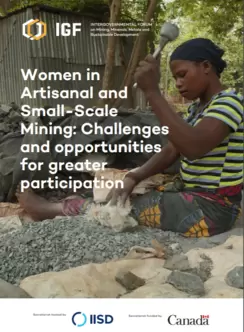
The various challenges women face within this sector have been sporadically highlighted in the literature, and a systematic and in-depth approach to understanding those challenges has been inadequate. With some research limitations, this paper takes a focused approach to understanding the key bottlenecks to women’s full participation with the aim of informing highly sought interventions to address those challenges.
This handbook is intended as a tool for due diligence and project planning by policy makers, development interventions, civil society, and downstream businesses operating in the artisanal and small-scale gold mining (ASGM) sector.
This handbook is intended as a tool for due diligence and project planning by policy makers, development interventions, civil society, and downstream businesses operating in the artisanal and small-scale gold mining (ASGM) sector.
This is the release of the first case study demonstrating application of the handbook’s methodology to analyse the IFFs surrounding the ASGM sector in Sierra Leone, showing its practical application and the importance of financial mapping to a meaningful understanding of ASGM.
The Special report on the implementation of the ICGLR RINR will start by analyzing certification processes in general and their challenges; focus on the ICGLR RINR and highlight the progress made as well as achievements and success factors; flag any issues and challenges that may have arisen that prevent its implementation; and make comparative analysis with other certification mechanisms and initiatives.
This report analyses African mining from a number of complemenary perspectives, driven by a search for new directions based on the African Mining Vision (AMV) which African leaders adopted in 2009.



Topics: