Global Initiative against Transnational Organized Crime,
Levin Sources
English
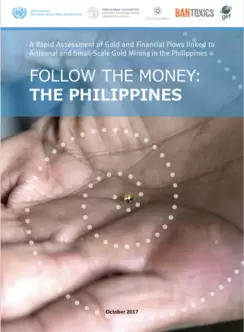
Levin Sources and the Global Initiative against Transnational Organized Crime produced two case studies identifying financial flows-both licit and illicit- in Mongolian and Filipino ASGM sectors. This report, focusing on The Philippines, provides a nuanced first-look at how stakeholders can better understand and respond to the role gold supply chains and financial flows play in formalization efforts.
Doris Buss, Blair Rutherford, Jennifer Hinton and Jennifer Stewart (Carleton University);,
Joanne Lebert and Gisèle Eva Côté (Partnership Africa Canada);,
Abby Sebina-Zziwa, Richard Kibombo and Frederick Kisekka (Development Research and Policy Analysis Center),
- Institute for the Study of International Development
English
This paper examines: the structural gender inequalities that impact on access to resources and relationships; gendered social and political institutions that structure ASM livelihoods; and gendered “meaning systems,” the discourses, terms, and metaphors that structure how mining and mining activities, and the women and men whose lives are enmeshed in those activities, are made knowable.
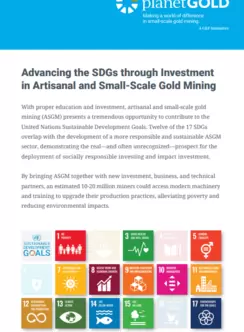
With proper education and investment, artisanal and small-scale gold mining presents a tremendous opportunity to contribute to the United Nations Sustainable Development Goals. Learn how 12 of the 17 SDGs overlap with the development of a more responsible and sustainable ASGM sector, demonstrating the real—and often unrecognized—prospect for the deployment of socially responsible investing and impact investment.
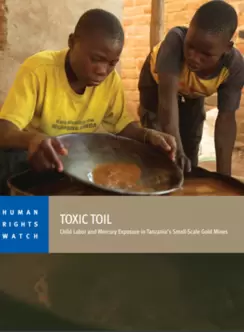
This report examines child labor and exposure to mercury in small-scale gold mining in Tanzania, Africa’s fourth-largest gold producer. It documents the harmful effects of mining on children, including its impact on the enjoyment of their rights to health, education, and protection from violence and abuse. The report focuses on hard rock mining, whereby small-scale miners remove and process rocks from pits to extract the ore. Human Rights Watch conducted research in Chunya district (southern Tanzania), in Geita and Kahama districts (northwestern Tanzania), and in the cities of Dar es Salaam, Mwanza, and Mbeya.
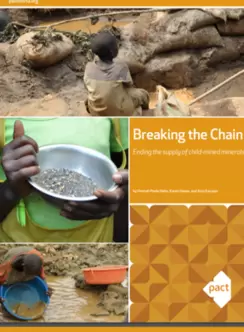
Artisanal and small-scale mining in the Democratic Republic of Congo, an economic activity upon which an estimated 12 to 15 percent of the population relies,2 often involves child labor. The complex economic and societal considerations that drive children to work in the cassiterite, coltan, and wolfram mines in the northern parts of the country’s Katanga province are complex. Pact undertook this study to better understand the motivating factors and the context that lead children to work in mines. Insights from this research enable Pact and others to implement appropriate, realistic interventions for child miners in the DRC.
En el marco de esa cooperación se realizó el estudio “Minería y Derechos Humanos: Una Mirada desde el Sector Artesanal y de Pequeña Escala”, que examina el potencial para aplicar el enfoque de los derechos humanos en la minería artesanal y de pequeña escala (MAPE), como instrumento para elevar la dignidad, evitar desigualdades y discriminación, pero también para fomentar las responsabilidades y obligaciones que conlleva, en ámbitos legales, sociales, económicos y laborales. Este documento presenta también un análisis del efecto de la formalización en los derechos en la MAPE, dado el elevado grado de informalidad en la minería artesanal, que
This document provides an approach to addressing health as part of the development of a National Action Plan (NAP) to reduce, and where feasible, eliminate mercury use as required under the Minamata Convention on Mercury.
Under the Convention, NAPs are a requirement for those Parties that determine that “artisanal and small-scale gold mining (ASGM) and processing in its territory is more than insignificant.” A NAP must include public health strategies on the exposure of artisanal and small-scale gold miners and their communities to mercury. Such strategies are expected to include gathering health data, training of health care workers, and
The mercury use and trade patterns in Sub-Saharan Africa have so far been difficult to assess by traditional statistics-based methods. This study aims at improving the understanding of mercury's role in the region through detailed investigation of import and export data in combination with field investigations in eight countries, literature study and a questionnaire survey sent to all countries in the region.
This report of the East Africa Research Fund (EARF) project ‘Understanding the Economic Contribution of Small-scale Mining in East Africa’ addresses the first of three main objectives of the Terms of Reference, namely to conduct an overarching synthesis to understand the impact of small-scale mining operations on economies and livelihoods in low to middle income countries, and explore the implications for three case study countries Kenya, Rwanda and Uganda in East Africa.
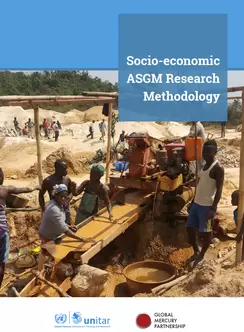
This socio-economic ASGM research methodology mainly covers the socio-economic aspects of the ASGM overview. It provides a suggested approach for collecting and analysing data in the ASGM sector. This socio-economic ASGM research methodology therefore supports NAP-executing countries in exploring key social, cultural, and economic aspects of the ASGM sector. This involves collecting mostly qualitative data at the local level, as well as addressing several quantitative indicators at the regional and national level.



Knowledge areas: