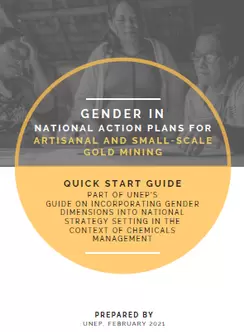
The Quick Start Guide summarizes and provides a visual overview of the key issues and recommendations for incorporating gender dimension into National Action Plans for artisanal and small scale gold mining. The document is based on the detailed guidance presented in UNEP's Guide on Incorporating Gender Dimensions into National Strategy Setting in the Context of Chemicals Management.
This paper reflects critically on the challenges with reducing women’s exposure to mercury at artisanal and small-scale gold mines in sub-Saharan Africa. It draws on findings from ongoing research in Ghana, the location of one of the largest and most dynamic artisanal and small-scale gold mining sectors in the region.
Gavin Hilson,
Steven Van Bockstael,
Titus Sauerwein,
Abigail Hilson,
James McQuilken
English
This article offers preliminary reflections on the potential impact of COVID-19 on artisanal and small-scale mining activities in sub-Saharan Africa. In doing so, it revisits the core ideas put forward in the literature in support of showcasing the sector more prominently in the region’s rural development strategies.
This brief outlines some of the main challenges to ASM sector support and regulation in the context of the global pandemic and points tentatively to how governments can move forward with effective ASM sector management in the coming months.
In December 2020 the planetGOLD Peru project team provided an update on: the resumption of ASGM activities in the country after restrictions were lifted; the price of gold; the incidence of COVID-19 in the country; and project activities in mining areas.
While the ASGM sector is present across Peru, the department of Madre de Dios is the epicenter of illicit alluvial gold extraction and the accompanying deforestation. This case study examines the complex drivers behind ASGM sector expansion, the devastating impacts on biodiversity in the region, and the strategies implemented to address the impacts of ASGM in Madre de Dios by the Government of Peru.
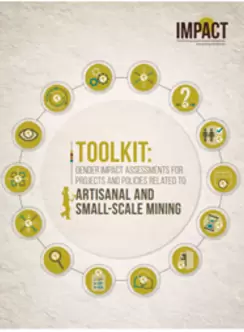
The toolkit was developed as part of IMPACT’s vision for natural resources to benefit all genders equally, over the course of IMPACT’s work in Democratic Republic of Congo and Uganda where the organization, along with its partners, identified gaps in tools available to analyze the impact on women in field-based projects addressing ASM formalization.
The OECD prepared this guidance to provide practical guidance to mining, oil and gas enterprises in addressing the challenges related to stakeholder engagement.
The OECD developed this guidance to help companies identify, mitigate and account for the risks of child labour in their mineral supply chains. It has been developed to build on the due diligence framework of the OECD Due Diligence Guidance.



Knowledge areas: