Massaki Fuse, Hiroumu Oda, Hiroki Noguchi, and Kenichi Nakajima
English
This study aims to detect the existence of illegal intercountry mercury trade under the social mercury phase-out movement, focusing on discrepancies in each country’s trade statistics.
Yingchao Cheng , Kenichi Nakajima, Keisuke Nansai, Jacopo Seccatore, Marcello M. Veiga, Masaki Takao
English
This study discusses a method to detect inconsistencies in data on global mercury trade, and calculated the gap between the demand and supply of mercury to the artisanal and small-scale gold mining sector (i.e., the largest source of Hg emissions globally) in 39 countries across four regions.
International Pollutants Elimination Network (IPEN)
English
This brief discusses the need to amend the Minamata Convention to end the mercury trade and establish a 2032 phase-out for ASGM as an allowable use of mercury.
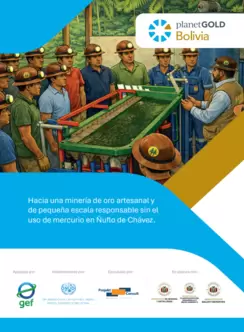
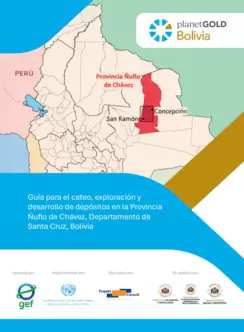
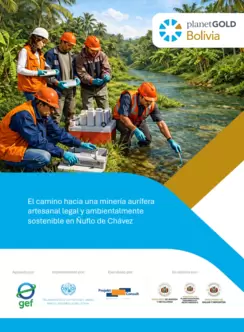
La geología prospectiva y la presencia de oro en la provincia de Ñuflo de Chávez ofrecen oportunidades para el desarrollo de negocios prósperos. Sin embargo, dado que la minería puede causar graves impactos negativos, si no se realiza correctamente, es crucial trabajar de una manera responsable. La minería responsable es una forma de producir minerales minimizando los impactos ambientales, protegiendo la salud de las personas y generando beneficios comunes para las y los actores mineros, instituciones y las comunidades.
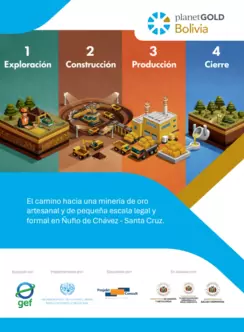
La minería se realiza en un ciclo, comenzando con la exploración y, si esta etapa tiene éxito, se desarrollan operaciones de extracción y procesamiento que, a su vez, algún día deberán cerrarse y rehabilitarse. Cada etapa de este ciclo se rige por requisitos legales específicos.
La minería de oro artesanal y de pequeña escala, es una actividad importante para la economía local y nacional. Sin embargo, para que esta actividad se realice de manera responsable y sostenible, es necesario cumplir con la normativa ambiental vigente.
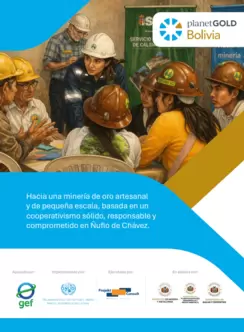
Principios básicos del cooperativismo. Hacia una minería de oro artesanal y de pequeña escala, basada en un cooperativismo sólido, responsable y comprometido en Ñuflo de Chávez.
The paper examines the link between poverty and artisanal and small-scale mining (ASM) in sub-Saharan Africa. It challenges the idea that ASM workers are simply trapped in a poverty cycle, using research on marginalized women in Ghana to add nuance. It argues that discussions should focus on how dependence on mining income, especially for women, can increase vulnerability rather than alleviate poverty.
This paper examines the local gender dynamics and division of labour in ASGM from research in Prestea-Huni Valley Municipality, Ghana. Findings show that while men were mainly engaged in the extraction – digging, shoveling and loading of women’s head pans with mineral ore – and processing work at the colluvial mining sites, women were basically working as laborers.



Topics: