A new report from the UN Environment Programme (UNEP) and the IGF maps over 100 Sustainability Standards and Initiatives operating across value chains to clarify how these interact with laws, regulations and policy commitments, and how they might enhance environmental governance rather than undermine it.
This report recommends that to safeguard northern Ghana from potential future exploitation, it is necessary to accelerate ASGM formalization, strengthen border security and intelligence sharing, disrupt illicit financial flows, enhance community-level early warning systems and address Fulani grievances.
This report series analyzes the forces behind illegal mining in Ghana, its geographic expansion, and the networks that benefit from it. Drawing on three years of fieldwork, remote sensing, interviews, and desk research, Part 1 focuses on the Western and Savannah regions, showing how unlicensed artisanal and small-scale gold mining has increased in scale, sophistication, and environmental and social impact. Part 2 will delve further into the illicit gold supply chains and financial systems that sustain the trade.
The report provides a comprehensive analysis of ASM’s current state, including tools, techniques, and technologies across the mining life cycle, along with addressing crosscutting issues like monitoring and enforcement, occupational health and safety, access to finance, and access to information.
The study reinterprets the economics of ASGM by focusing on net price discovery—the real value miners retain after subtracting production costs, environmental harms, and rents captured by more powerful actors, rather than simply looking at gross revenues or total output.
Secretariat of the Minamata Convention on Mercury
English
This new publication presents an assessment of how projects funded by the Specific International Programme (SIP) under the Minamata Convention integrate considerations related to women and girls in their design and implementation.
The second edition of Stories from the Field, highlights planetGOLD Uganda's ongoing commitment to advancing a mercury-free artisanal and small-scale gold mining sector. This edition shows the experiences of miners who have embraced mercury-free technologies at their sites, sharing their personal journeys, challenges, and successes. It also offers clear and practical technical insights into the alternative methods miners can adopt as part of the transition to safer, cleaner, and more responsible gold mining practices.
While women are active in the artisanal and small-scale gold mining (ASGM) workforce, they also typically face a range of gender-specific barriers that prevent their full participation. The planetGOLD programme is committed to supporting and creating sustainable opportunities that strengthen gender inclusiveness in ASGM. Country projects take several measures to ensure the active inclusion of women’s voices and concerns in all phases of their projects, from stakeholder engagement (such as project kick-off meetings, trainings, and steering committees) to special gender baseline studies and gender equity planning, to the design of specific
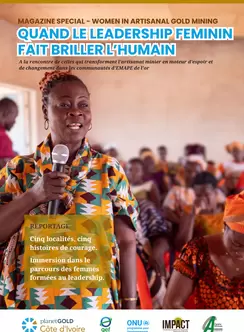
Le magazine Woman in Artisanal Gold Mining met en lumière les femmes qui transforment le secteur de l’exploitation minière artisanale et à petite échelle de l’or (EMAPE) en Côte d’Ivoire. Fruit d’une mission de terrain conduite par le projet planetGOLD Côte d’Ivoire, ce numéro spécial valorise le leadership féminin, l’autonomisation économique et l’inclusion sociale des femmes artisanes, dirigeantes de coopératives et actrices institutionnelles.
Excellent O. Eboigbe1 , Nimelan Veerasamy, Abiodun M. Odukoya, Nnamdi C. Anene, Jeroen E. Sonke, Sayuri Sagisaka Méndez , and David S. McLagan
English
This study investigates mercury biogeochemical cycling and mercury uptake mechanisms in three common staple crops at a contaminated farm from an artisanal and small-scale gold mining processing site and a background farm in Nigeria.



Topics: