National Environment Management Authority (NEMA) - Uganda
English
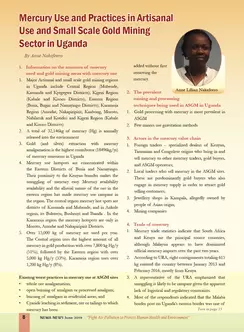
In this 2019 edition of the NEMA newsletter, Anne Nakafeero authors an article beginning on page 8 detailing key facts and figures on the ASGM sector in Uganda
National Environment Management Authority (NEMA) - Uganda
English
The Minamata Initial Assessment (MIA) project in Uganda was conducted to strengthen national decision making towards ratification of the Minamata Convention and build capacity towards implementation of future provisions. This report provides the results of the Minamata Initial Assessment in Uganda.
National Environment Management Authority (NEMA) - Uganda
English
The National Action Plan (NAP) for Artisanal and Small Scale Gold Mining (ASGM) details Uganda’s commitment to reducing and where feasible eliminating mercury use in the ASGM sector which includes specific, realistic and time-bound objectives, strategies and interventions including anticipated key institutions for realising the commitment.
Descripción y avance de actividades del proyecto “Gestión Integrada del Mercurio en la Minería de Oro Artesanal y de Pequeña Escala en el Perú - planetGOLD Perú” en las regiones de Arequipa, Piura y Puno durante el 2021
El estudio analiza la situación de los hombres y las mujeres que trabajan en la Minería Artesanal y de Pequeña Escala (MAPE) de oro en el Perú, bajo tres perfiles: hombres y mujeres en la MAPE -socios/as, cargos directivos, consultores/as, trabajadores/as dentro de la operación minera- y mujeres seleccionadoras de mineral -más conocidas como “pallaqueras”.
This report describes a workshop for government officials in Niger that promoted a national dialogue on ASM governance challenges related to illicit financial flows and conflict.
El documento muestra las brechas de género en la minería artesanal y pequeña minería en el Perú y brinda recomendaciones para la elaboración de un plan de acción con enfoque de género que promueva la igualdad de derechos y oportunidades en el sector. También disponible en ingles.
In this planetGOLD Kenya video interview, artisanal miner Timothy Mukoshi from Kakamega County describes the impacts that formalization status has on miners' ability to access finance in order to shift to more responsible, mercury-free artisanal gold mining practices.






Countries: