The guidelines provide basic practical guidance for the environmentally sound storage, handling, and transport of liquid mercury and mercury wastes in Peru, particularly wastes consisting of used elemental mercury and mercury contaminated materials. The guidance is adapted to the needs of Peru, which aims to progressively eliminate mercury use in artisanal and small-scale mining, and has committed to manage mercury wastes in compliance with the Minamata and Basel conventions.
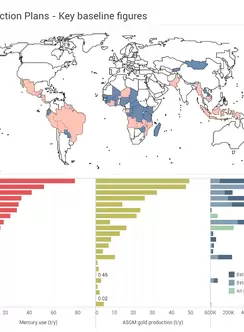
To assess the wealth of information generated in Minamata Convention National Action Plans (NAP) for ASGM sector, the finalized documents have been reviewed and quantitative and qualitative data has been extracted. Visit the website to explore the full database using the dynamic dashboards, browse thematic stories and see collection of maps with ASGM locations/regions extracted from the countries' NAP documents.
Guidance developed by the Association of Women in Energy & Extractives in Kenya (AWIEK) for response and prevention of sexual and gender based violence for women in mining.
The IGF has released a new report that examines artisanal and small-scale gold mining (ASGM) in border areas plagued by conflict and violence in Burkina Faso, Mali, and Niger.
A brief guide for mining entities, engaged under the planetGOLD Programme, whom are required to submit a planetGOLD Environmental and Social Risk Assessment Report, thereby providing evidence of conformance with the planetGOLD Criteria.
In addition to incorporating elements of the CRAFT Code, the planetGOLD Criteria includes three additional that are specific to the planetGOLD Programme. Mining Entities engaged under the planetGOLD Programme are required to submit this planetGOLD Environmental and Social Risk Verification Form, thereby providing evidence of conformance with the planetGOLD Criteria.



Knowledge areas: