The first planetGOLD Technology without Mercury virtual exhibit took place October 6-7 2021. This resource offers all presentations however, because certain presentations included audio, all recordings of both days can be found on the planetGOLD event page.
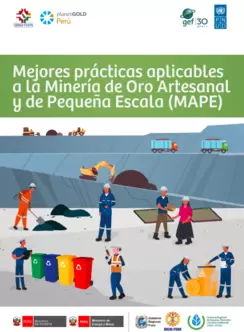
Elaboradas con un lenguaje amigable y material fotográfico, estas guías contienen recomendaciones de mejora para implementar en los procesos productivos de las organizaciones mineras y, de esa manera, optimizar sus actividades en el manejo ambiental, socioeconómico y de salud.
Natalia Uribe Martínez,
Jim Sanchez Gonzalez,
Lorenzo Pellegrini
English
In this study, the authors estimate the impact of the Fairmined certification scheme on the well-being of participating artisanal and small-scale gold miners in Colombia and Peru. The results indicate that, on average, Fairmined certified miners enjoy higher well-being scores than those who do not belong to a certified mining organization.
This educational course was developed to support the training of public health and health-care professionals, medical and other allied students and professionals, and decision-makers in the health and environmental sectors. It compiles information on human exposure to different types of mercury and their health effects, the use of mercury in the health sector, and the policy and technical documents guiding preventive actions at a national level.
This joint guidance has been developed to support gender mainstreaming in the development of artisanal and small-scale gold mining National Action Plans (NAPs) in line with Annex C of the Minamata Convention on Mercury, as well as for the development of National Implementation Plans (NIPs) for the management of persistent organic pollutants in line with the Stockholm Convention. The document provides guidance on incorporating gender dimensions throughout the process and into strategic content of both NAPs and NIPs. The Annexes present detailed considerations and tools relevant for both and specific to NAPs and NIPs
Cristiano Lanzano, Sabine Luning, Alizèta Ouédraogo,
The Nordic Africa Institute
English
As artisanal gold mining in Burkina Faso has increased in recent years, so have violent attacks by non-state armed groups. The assumption that there is a natural causal link between the two is, however, too simplistic. The escalating violence should rather be seen as a result of long-term trends, such as state disengagement, a growing dependence on gold and the gradual privatisation of security. This paper recommends that policy makers avoid a repressive approach to artisanal mining and rethink the governance of the sector, in consultation with miners and rural communities.
The Impact Facility,
Cyrus Maina, Andrew Moore & David Sturmes
English
Since 2018, The Impact Facility has been looking for practical ways to manage, mitigate an eliminate mercury use in the ASGM space. This report presents work carried out in mercury use sensitisation, with more than a dozen artisanal mining groups in Kenya, Uganda and Tanzania, reflecting on successes, challenges and failures experienced along the way
This report aims to map issues related to responsible business conduct in the production and trade of gold in Venezuela, in order to support companies implementing the recommendations of the OECD Due Diligence Guidance for Responsible Supply Chains of Minerals from Conflict-Affected and High-Risk Areas to exercise their due diligence.
With the Government of Kenya’s latest investments in its small-scale domestic gold sector, including its own refining capabilities, the time is right to tackle the drivers of illicit trade.
This document was created to guide the training of health practitioners on certain health risks that are common in the sector. While there are many health risks in the ASGM sector, this guide is limited to risks specifically related to ASGM, particularly those that are rarely covered by general university professional trainings.



Knowledge areas: