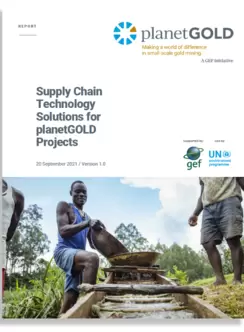
Despite producing an estimated 20% of the world’s annual supply of newly mined gold, the ASGM sector has traditionally had challenges connecting with the formal world gold market. While numerous formal buyers are eager for gold produced by artisanal and small-scale gold miners, meeting rigorous standards for due diligence standards and responsible sourcing poses a challenge. This study examines the role that can be played by supply chain technologies in facilitating conformity with the planetGOLD Criteria by looking at specific types of supply chain solutions, including due diligence, traceability and block-chain solutions, and analyzing
D. Stapper, K. Dales, P. Velasquez y S. Keane
Spanish
La falta de orientaciones aplicables a la gestión del cianuro en el sector de la minería de oro artesanal y de pequeña escala (MAPE) requiere una atención urgente, especialmente teniendo en cuenta la accesibilidad y la eficacia del cianuro en la extracción de oro, y a la luz de la tendencia en la adopción de la cianuración en el sector de la minería de oro de pequeña escala en todo el mundo. El propósito de este documento es colmar esta laguna proporcionando orientaciones escritas a las partes interesadas del sector de la MAPE sobre la gestión de los riesgos de la cianuración cuando los marcos jurídicos y normativos nacionales permitan su uso
Cristian Arias, Kamila Gómez, and Abdoulata Dabiré, Alliance for Responsible Mining
English
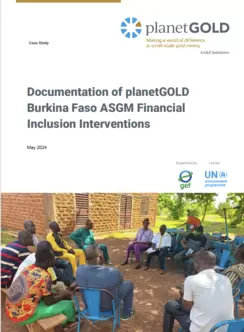
This case study documents the finance models implemented by the planetGOLD Burkina Faso project in artisanal and small-scale gold mining (ASGM) communities, with a consideration of the gender aspects of the projects.
This research paper seeks to outline and assess the social, economic, political and cultural barriers that women face thereby, hindering them from fully participating in ASGM in Zimbabwe.
Assheton S. Carter, Candice Jumwa & David Sturmes-Verbeek, The Impact Facility
EnglishFrenchSpanish
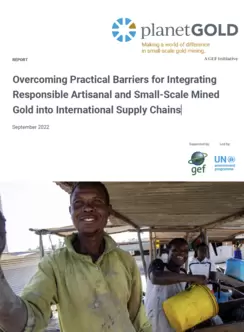
When artisanal and small-scale miners produce gold observing relevant environmental, social and governance standards, practical barriers to accessing international markets typically still remain. This report aims to inform the funders, leaders, and managers of existing and planned ASGM Market Access Initiatives, to highlight the impediments such initiatives face in establishing a flow of formal responsible ASM gold into international markets.
David Sturmes-Verbeek and Candice Jumwa, The Impact Facility
English
This case study documents the finance models implemented by the planetGOLD Philippines project in artisanal and small-scale gold mining (ASGM) communities, with a consideration of the gender aspects of the projects.
This module strengthens the capacity of miners and cooperative leaders to run ASGM operations as sustainable businesses. Participants will learn entrepreneurial skills, basic cooperative registration procedures, and how to prepare and manage financial records. The training also introduces tools for financial planning and reporting, and explores strategies for engaging with financial institutions and potential investors. Emphasis is placed on transparency, accountability, and sound decision-making for both individual miners and mining cooperatives.
This module introduces participants to the legal and institutional framework governing ASGM sector in the Philippines. It covers the salient features of national laws, such as RA 7076 and RA 7942, as well as relevant administrative orders and local permitting processes imposed by local government units (LGUs).Participants will also explore international standards and conventions like the Minamata Convention and OECD Due Diligence Guidelines and how they relate to national policies and compliance requirements. The session concludes with a practical walkthrough of the formalization process, focusing on the steps needed to establish and sustain
This module promotes inclusive and equitable participation in the ASGM sector by integrating gender perspectives into mining operations, organizational development, and community decision-making. It introduces gender analysis tools, GAD (Gender and Development) planning, and leadership development strategies tailored for ASGM cooperatives and associations. Through real-life case studies, participatory exercises, and self-assessment tools, participants will explore how to promote women’s leadership and reduce gender-based disparities.



Knowledge areas: