D. Stapper, K. Dales, P. Velasquez, and S. Keane
EnglishFrenchSpanish
The gap in applicable guidance for cyanide management in the artisanal and small-scale gold mining (ASGM) sector requires urgent attention, especially considering cyanide’s accessibility and effectiveness at gold extraction, and in light of the trend in uptake of cyanidation in the small-scale gold mining sector worldwide. This document addresses this gap by providing written guidance for ASGM stakeholders on managing the risks of cyanidation where national legal and regulatory frameworks permit its use, in the context of the ASGM sector’s transition from mercury use.
Julia Queiroz, Pedro Gasparinetti, Leonardo B. Bakker, Felipe Lobo, Gustavo Nagel
English
The objective of this study was to develop a methodology for assessing the socio-environmental costs of dredge boat mining in the Tapaj´os watershed, using a method linking the type of gold mining, type of pump, motor power required, time spent in exploration, and mercury use with the average socioeconomic cost. The findings can contribute to a more accurate economic valuation of illegal dredge boat mining, providing valuable information for estimating compensation fines and planning law enforcement investments to prevent illegal ASGM.
The use of cyanide in the ASGM sector continues to be an important topic as it is easy to access and can be affordable. However, using cyanidation of mercury-contaminated ASGM tailings constitutes a “worst-practice” as defined in the Minamata Convention. Explore the documents in this collection, which provide a range of information on the controversial topic.
Curated collections include some of the most useful and relevant resources on key ASGM topics, selected by the planetGOLD team. Click here to view all of the collections.
The planetGOLD programme works to make small-scale gold mining safer, cleaner, and more profitable from mine to market—by closing the financing gap, supporting formalization, and connecting miners with mercury-free technology and formal markets.
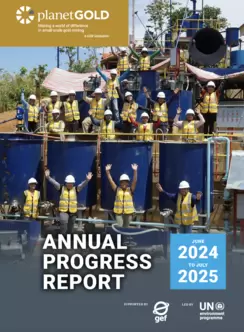
The 2024-2025 Annual Progress Report provides an overview of the progress made in these four key programmatic areas, and in other aspects of the programme including mainstreaming gender equality along with awareness raising and communication outreach. The report includes data from the national projects and the global coordination project.
This joint guidance has been developed to support gender mainstreaming in the development of artisanal and small-scale gold mining National Action Plans (NAPs) in line with Annex C of the Minamata Convention on Mercury, as well as for the development of National Implementation Plans (NIPs) for the management of persistent organic pollutants in line with the Stockholm Convention. The document provides guidance on incorporating gender dimensions throughout the process and into strategic content of both NAPs and NIPs. The Annexes present detailed considerations and tools relevant for both and specific to NAPs and NIPs
Access to appropriate financing mechanisms helps miners improve efficiency and go mercury-free. For analysis of ASGM financial access interventions undertaken by projects in phase one of the planetGOLD programme, as well as six other initiatives outside the planetGOLD programme, visit the resource page Analysis of Financial Interventions for the ASGM Sector.
Curated collections include some of the most useful and relevant resources on key ASGM topics, selected by the planetGOLD team. Click here to view all of the collections.
The planetGOLD programme works to make small-scale gold mining safer, cleaner, and more profitable from mine to market—by closing the financing gap, supporting formalization, and connecting miners with mercury-free technology and formal markets.
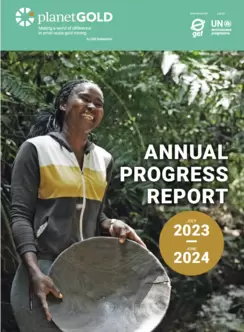
The 2023-2024 Annual Progress Report provides an overview of the progress made in these four key programmatic areas, and in other aspects of the programme including mainstreaming gender equality and outreach and communications. Available in English, French and Spanish, the report includes data from the national projects and the global coordination project.
We are working toward the formalization and professionalization of the artisanal and small-scale gold mining (ASGM) sector in Mongolia, including the elimination of mercury use in gold processing. Collaborating with stakeholders along the gold supply chain – miners, gold traders, local and national governments as well as civil society – will allow us to sustainably improve artisanal mining operations as an important economic opportunity for remote communities and to support the revision of regulations governing the sector. For regular project updates, follow us on Facebook and Twitter.
We are working toward the formalization and professionalization of the artisanal and small-scale gold mining (ASGM) sector in Mongolia, including the elimination of mercury use in gold processing. Collaborating with stakeholders along the gold supply chain – miners, gold traders, local and national governments as well as civil society – will allow us to sustainably improve artisanal mining operations as an important economic opportunity for remote communities and to support the revision of regulations governing the sector. For regular project updates, follow us on Facebook, Twitter, and LinkedIn.
Pact Zimbabwe has piloted trainings to enhance artisanal and small-scale gold miners’ skills in three districts: Gwanda, Kwekwe and Shurugwi. Trainings have covered topics which include; safety and environment management, mining legislation, efficient mining techniques, mercury abatement, child labour, gender equality & mining and financial literacy. To ensure trainings are replicable and sustainable beyond the life of ZAAMP, and to build the capacity of local organizations to conduct similar trainings, Pact Zimbabwe consolidated training materials into a Training Handbook





Knowledge areas: