One of the GOLD-ISMIA objectives is to avoid 15 tonnes of mercury through the introduction of Best Environment Practices (BEP), Best Available Technology (BAT) and socially and environmentally sound Artisanal and Small-scale Gold Mining (ASGM) practices where the Project will establish 1 mercury-free processing plant and 5 small-mobile plant. The decision of implementation BEP and BAP at each of mining site will be depending upon the result of socio-economic baseline survey (including collection of sex-disaggregated data) and mercury/gold mass balance inventories.
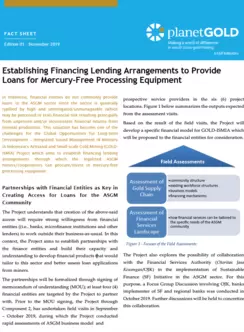
In Indonesia, financial entities do not commonly provide loans to the ASGM sector since the sector is generally typified by high and unmitigated/unmanageable (which may be perceived or real) financial risk resulting principally from unproven and/or inconsistent financial returns from mineral production. This situation has become one of the challenges for the Global Opportunities for Long-term Development – Integrated Sound Management of Mercury in Indonesia’s Artisanal and Small-scale Gold Mining (GOLDISMIA) Project which aims to establish financing lending arrangements through which the legalized ASGM miners/cooperatives can procure/invest
One of the GOLD-ISMIA objectives is to avoid 15 tonnes of mercury through the introduction of Best Environment Practices (BEP), Best Available Technology (BAT) and socially and environmentally sound Artisanal and Smallscale Gold Mining (ASGM) practices where the Project will establish 1 mercury-free processing plant and 5 small mobile plant. The decision of implementation BEP and BAP at each of mining site will be depending upon the result of socio-economic baseline survey (including collection of sex-disaggregated data) and mercury/gold mass balance inventories.
Under Component 1, the Global Opportunities for Long-Term Development – Integrated Sound Management of Mercury in Indonesia’s Artisanal and Small-Scale Gold Mining (GOLD-ISMIA) Project aims to establish national systems whose capacity to assess, plan and implement sustainable and mercury-free interventions in the ASGM sector. The Project also aims to create enabling environment through improved national policies and regulatory frameworks for ASGM and mercury phase-out in the sector.
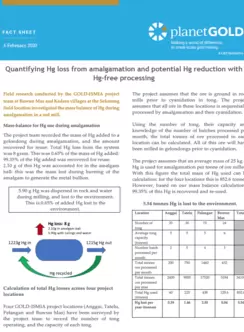
Field research conducted by the GOLD-ISMIA project team at Buwun Mas and Kedaro villages at the Sekotong field location investigated the mass balance of Hg during amalgamation in a rod mill
Component 2 efforts in achieving the objectives of the GOLD-ISMIA Project, especially the establishment of a financing system for the provision of loans in the context of purchasing gold processing equipment without mercury, have been carried out in accordance with the references contained in the Project Document and also based on the results of previous studies on the conditions of access to financing for ASGM from Financial Services. Barriers and obstacles faced in achieving these goals, especially related to the output target of the realization of the financing program from financial services for ASGM to have mercury-free gold processing
The potential gold reserves at Boliyohuto Mountain (2,065m), located in Hulawa Vilage, Sumalata Timur District, North Gorontalo Regency has attracted legal and illegal mining attention for over 150 years. Local miners first exploited the resource in 1865 and then in 1885 the Bauermann family from the Netherlands began mining operations. In 1896, a mining permit was granted by the Dutch Government to NV. Mijnbouw Maatschappij “Soemalata”.
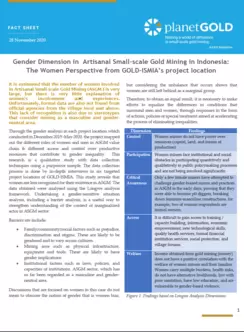
Gender analysis is the study of the different roles of women and men in order to understand what they do, what resources they have, and what their needs and priorities . GOLD-ISMIA uses gender analysis to address differentiated access to and control over resources and decision making within six ASGM locations
It is estimated that the number of women involved in Artisanal Small-scale Gold Mining (ASGM ) is very large, but there is very little explanation of women's involvement and experiences. Unfortunately, formal data are also not found from official agencies from the village level and above. This lack of recognition is also due to stereotypes that consider mining as a masculine and gender-neutral area.
GOLD ISMIA’s goal is to reduce mercury (Hg) use in ASGM by 15 ton in 3 years working together with GOLD ISMIA’s and BPPT to lead the assessment and implementation of technology that will allow Indonesian ASGM miners to transition to mercury-free technology through provision of technical assistance, technology transfer and support for formalization.



Countries: