One of the most significant barriers to the development of a responsible ASGM sector is access to finance. Finance entities including banks, microfinance institutions, and other lenders do not commonly provide loans/credit/financing to the ASGM sector as the risks are often perceived to be too high and such entities do not have the expertise and experience to review ASGM loan applications or develop financial products that are tailored to the ASGM sector. On the other hand, miners’ cooperatives and organizations do not have much experience in record keeping and reporting or the preparation of loan applications, which can increase their access
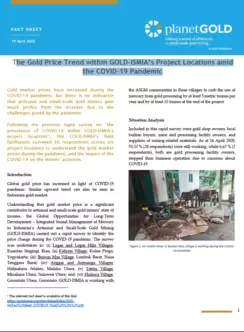
Gold market prices have increased during the COVID-19 pandemic, but there is no indication that artisanal and small-scale gold miners gain much profits from the increase due to the challenges posed by the pandemic.
Access to finance is one of the most significant and pernicious barriers of the ASGM sector. Miners’ cooperatives and organizations need investment to fund their mining operations, but do not have the requisite capacity and experience to access conventional financing options. From the lending perspective, finance entities (banks, microfinance institutions, and other lenders) do not commonly provide loans to the ASGM sector as the risks are often perceived to be too high. The risk status of the ASGM sector relates to the lack of legal status of mining operations and inconsistency in gold production. Traditional finance entities do not have the
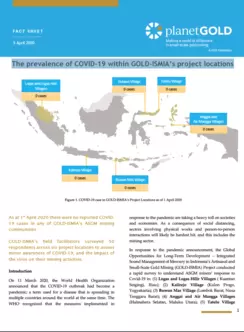
As at 1st April 2020 there were no reported COVID-19 cases in any of GOLD-ISMIA’s ASGM mining communities.
GOLD-ISMIA’s field facilitators surveyed 50 respondents across six project locations to assess miner awareness of COVID-19, and the impact of the virus on their mining activities.
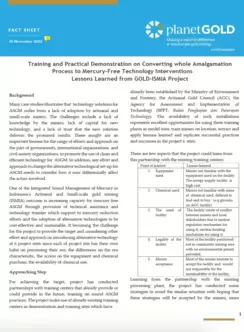
case studies illustrates that technology solutions for ASGM suffer from a lack of adoption by artisanal and small-scale miners. The challenges include a lack of knowledge by the miners, lack of capital for new technology, and a lack of trust that the new solution delivers the promised results. These insight are an important lessons for the range of efforts and approach on the part of governments, international organizations, and civil society organizations, to promote the use of clean and efficient technology for ASGM. In addition, any effort and approach to change the alternative technological set-up for ASGM needs to consider how it may
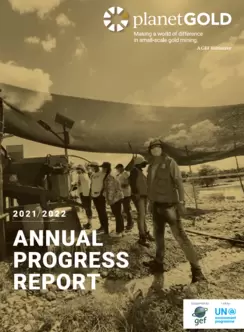
This report documenting planetGOLD’s progress from July 2021 through June 2022 shows how project teams in planetGOLD made key advances toward helping miners go mercury-free, by improving miners’ awareness of the dangers of mercury use, educating and demonstrating to them viable technical alternatives, and progressing in creating an enabling regulatory and financial environment that supports miners to undertake this transition.
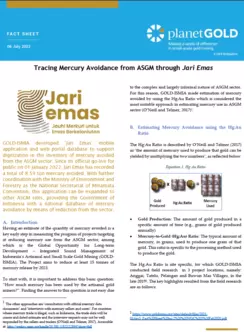
GOLD-ISMIA developed ‘Jari Emas’ mobile application and web portal database to support digitization in the inventory of mercury avoided from the ASGM sector. Since its official go-live for public on 01 January 2022, Jari Emas has recorded a total of 8.59 ton mercury avoided. With further coordination with the Ministry of Environment and Forestry as the National Secretariat of Minamata Convention, this application can be expanded to other ASGM sites, providing the Government of Indonesia with a national database of mercury avoidance by means of reduction from the sector.
Formalization of Artisanal and Small Scale Gold Mining (ASGM) miners is an important step towards the reduction and phase-out of mercury from the sector. This view is embedded within the Global Opportunity for Long-term Development – Integrated Sound Management of Indonesia’s Artisanal and Small Scale Gold Mining (GOLD-ISMIA) Project.
One of the GOLD-ISMIA objectives is to avoid 15 tonnes of mercury through the introduction of Best Environment Practices (BEP), Best Available Technology (BAT) and socially and environmentally sound Artisanal and Small-scale Gold Mining (ASGM) practices where the Project will establish 1 mercury-free processing plant and 5 small-mobile plant. The decision of implementation BEP and BAP at each of mining site will be depending upon the result of socio-economic baseline survey (including collection of sex-disaggregated data) and mercury/gold mass balance inventories.


Countries: