Morgane M.C. Fritz; Peter A. Maxson; and Rupert J. Baumgartner
English
For many years, the use of mercury in ASGM has afforded an income for many persons without better options, but has brought with it extensive harm to the environment, the miners and their communities. This paper analyzes the stakeholders and their diverse roles with regard to the trade and supply of mercury for Artisanal and Small-scale Gold Mining and applies a supply chain management approach to stakeholder theory.
Samuel J. Spiegel; Sumali Agrawal; Dino Mikhab; Kartie Vitamerry; Philippe Le Billon; Marcello Veigad; Kulansi Konoliusb; and Bardolf Paul
English
This article uses an ecological economics approach to analyse tensions surrounding efforts to phase out mercury in Indonesia's artisanal and small-scale gold mining (ASGM) sector, among the largest sources of mercury pollution worldwide. It also discusses implications of domestic cinnabar mining for controlling mercury in Indonesia's ASGM sector, highlighting obstacles to implementing the Minamata Convention, a treaty that aims to restrict mercury use.
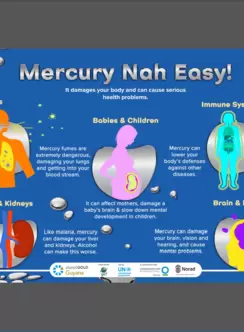
This set of posters created by the planetGOLD Guyana project provides information about the dangers of mercury exposure, health problems it can cause, and practical tips miners can take to reduce the risk of exposure for themselves and their families.
N. Raoilimanantsoa , J. Oremo , O. Akello , W. Majanga , S. Gunter , G. Ayodo , M.Torkmahalleh and S.Dorevitch
English
While there is data around concentrations of metals in surface waters near ASGM activities, little is known about concentrations of metals in the water-ore-mercury slurry with which workers have extensive dermal contact. The authors of this publication seek to characterize those concentrations.
This educational course was developed to support the training of public health and health-care professionals, medical and other allied students and professionals, and decision-makers in the health and environmental sectors. It compiles information on human exposure to different types of mercury and their health effects, the use of mercury in the health sector, and the policy and technical documents guiding preventive actions at a national level.
GOLD-ISMIA developed ‘Jari Emas’ mobile application and web portal database to support digitization in the inventory of mercury avoided from the ASGM sector. Since its official go-live for public on 01 January 2022, Jari Emas has recorded a total of 8.59 ton mercury avoided. With further coordination with the Ministry of Environment and Forestry as the National Secretariat of Minamata Convention, this application can be expanded to other ASGM sites, providing the Government of Indonesia with a national database of mercury avoidance by means of reduction from the sector.
One of the GOLD-ISMIA objectives is to avoid 15 tonnes of mercury through the introduction of Best Environment Practices (BEP), Best Available Technology (BAT) and socially and environmentally sound Artisanal and Small-scale Gold Mining (ASGM) practices where the Project will establish 1 mercury-free processing plant and 5 small-mobile plant. The decision of implementation BEP and BAP at each of mining site will be depending upon the result of socio-economic baseline survey (including collection of sex-disaggregated data) and mercury/gold mass balance inventories.




Countries: