Secretariat of the Minamata Convention on Mercury
English
This publication is based on the annex to document UNEP/MC/COP.6/INF/27, in which the secretariat, following decision MC-5/17, worked to develop a technical document to facilitate integration of actions to reduce mercury pollution from ASGM into the Kunming-Montreal Global Biodiversity Framework National Biodiversity Strategies and Action Plans (NBSAPs).
United Nations Environment Programme ,
Minamata Convention on Mercury
English
This report was developed in response to decision MC-4/4 by the Conference of the Parties to the Minamata Convention on Mercury, at its fourth meeting, where it requested the Secretariat “to compile views on the needs and priorities of indigenous peoples and local communities with regard to the use of mercury in artisanal and small-scale gold mining”.
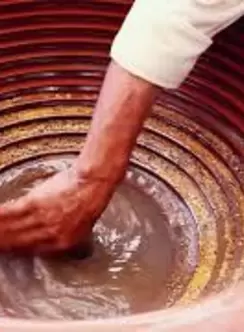
The planetGOLD Guyana project is assisting artisanal and small-scale gold mining communities implement mercury-free technologies that also increase yield and profits. This video demonstrates the use of three types of equipment that concentrate gold from alluvial deposits without using mercury - the gold kacha, gold cube, and blue bowl. The devices can be used in combination with each other and with other equipment to create an efficient and mercury-free gold recovery process.
International Pollutants Elimination Network (IPEN)
English
This brief discusses the need to amend the Minamata Convention to end the mercury trade and establish a 2032 phase-out for ASGM as an allowable use of mercury.
Jashaf Shamir A. Lorenzo, BAN Toxics,
IUCN - National Committee of the Netherlands
English
This report documents the illicit mercury flows in Mindanao, Philippines as well as the various governance practices for mercury in the study areas. The study is conducted by BAN Toxics and focuses on Artisanal and Small-Scale Gold Mining (ASGM) communities in the island, where the majority of illicit mercury enters the country.
Interactive, online guide that synthesizes and connects existing information on mercury-free practices in the ASGM sector through simple graphs, decision trees and illustrative success stories.This guide builds upon the UNEP Technical Guide: "Reducing Mercury Use in Artisanal and Small-Scale Gold Mining: A Practical Guide"
Danny Tobin OpeDanny Tobin , Alexander Pfaff , Dayron Monroy , Bryan Salgado-Almeida , Adam M. Kiefer and Daniel Garces
English
The study focuses on an alternative to the miners processing ore themselves; instead small miners sell their ore to plants employing larger-scale, mercury-free technologies that also raise gold yields. Taking an interesting lens the researchers assessed the ore-selling preferences of female waste-rock collectors (jancheras) in Ecuador, using a discrete-choice experiment.
This document provides an annotated bibliography of World Health Organization (WHO) key information resources relevant to the Minamata Convention on Mercury and the associated World Health Assembly Resolution WHA67.11 Public health impacts of exposure to mercury and mercury compounds: the role of WHO and ministries of public health in the implementation of the Minamata Convention. [Arabic, Chinese, English, French, Russian, Spanish.]
Jacqueline R. Gerson; Natalie Szponar; Angelica Zambrano; David C. Evers; Luis E. Fernandez; et al.
English
This paper shows for the first time that an intact forest canopy near artisanal gold mining intercepts large amounts of particulate and gaseous mercury, at a rate proportional with total leaf area. The study documents substantial mercury accumulation in soils, biomass, and resident songbirds in some of the Amazon’s most protected and biodiverse areas, raising important questions about how mercury pollution may constrain modern and future conservation efforts in these tropical ecosystems.
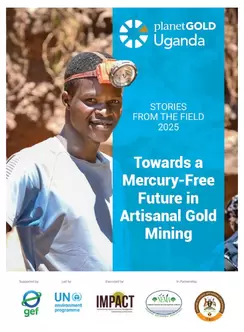
The second edition of Stories from the Field, highlights planetGOLD Uganda's ongoing commitment to advancing a mercury-free artisanal and small-scale gold mining sector. This edition shows the experiences of miners who have embraced mercury-free technologies at their sites, sharing their personal journeys, challenges, and successes. It also offers clear and practical technical insights into the alternative methods miners can adopt as part of the transition to safer, cleaner, and more responsible gold mining practices.




Topics: