K.J. Bansah, N.K. Dumakor-Dupey, B.A. Kansake, E. Assan, and P. Bekui
English
The paper includes a case study of an informal ASM-affected community located in the Western Region of Ghana. A two-phase mixed-method approach consisting of literature reviews, questionnaires, interviews, and water quality assessments was employed.
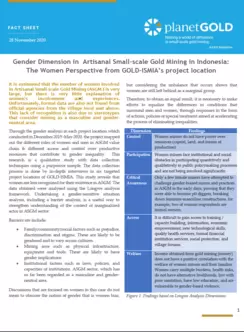
It is estimated that the number of women involved in Artisanal Small-scale Gold Mining (ASGM ) is very large, but there is very little explanation of women's involvement and experiences. Unfortunately, formal data are also not found from official agencies from the village level and above. This lack of recognition is also due to stereotypes that consider mining as a masculine and gender-neutral area.
This study reveals that women are less recognized for their existence in ASGM. Undertaking a gender-sensitive situation analysis, including a barrier analysis, is a useful way to strengthen understanding of the context of marginalized actor in ASGM sector
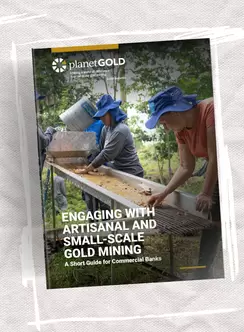
This brochure is meant for sharing with representatives of commercial banks that may be interested in investing in artisanal and small-scale gold mining operations. It gives an overview of the sector and its financing needs, business opportunities, ways to de-risk the sector, and additional resources on the topic.
Houdet J., Muloopa H., Ochieng C., Kutegeka S. and Nakangu B.
English
The full range of economic, social and environmental costs and benefits of large scale mining and artisanal and small scale mining remain unclear in Karamoja, Uganda. This study aims to conduct an economic, social and environmental cost-benefit analysis of LSM and ASM in the region, with a view to helping inform policy makers, civil society, mining companies, and development agencies on best bet policy, legal, regulatory, investment and environmental frameworks for responsible and equitable mining.
Cristian Arias, and Kamila Gómez, Alliance for Responsible Mining
English
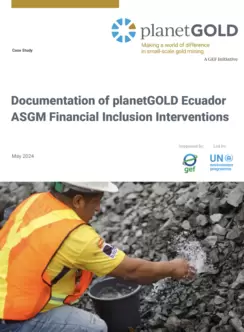
This case study documents the finance models implemented by the planetGOLD partner project in Ecuador in artisanal and small-scale gold mining (ASGM) communities, with a consideration of the gender aspects of the projects.
The article draws on the certification requirements of 20 responsible mining initiatives globally and analyses their dual role in transforming on the one hand the responsible mining initiatives themselves and the certified companies as well as the mining practice.
Edmond N’Bagassi Kohio, Seyram Kossi Sossou , Hela Karoui and Hamma Yacouba
English
ASGM in Burkina Faso increasingly relies on cyanide, intensifying concerns about environmental contamination and human exposure. This study assessed free cyanide levels in water and soil across three ASGM sites—Zougnazagmiline, Guido, and Galgouli.
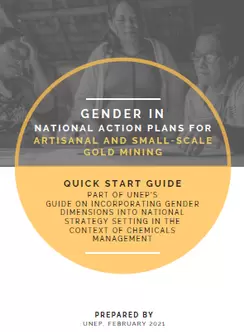
The Quick Start Guide summarizes and provides a visual overview of the key issues and recommendations for incorporating gender dimension into National Action Plans for artisanal and small scale gold mining. The document is based on the detailed guidance presented in UNEP's Guide on Incorporating Gender Dimensions into National Strategy Setting in the Context of Chemicals Management.




Knowledge areas: