

Voices
04 July 2022
Knowledge Areas:
-
 Founder/Director of tbb.hru, Austria | Board member of ARM, Colombia
Artisanal and small-scale mining (ASM, or ASGM when referring to artisanal and small-scale gold mining) is a topic that comes with a lot of told myths and untold truths. One of them is the global number of ASM miners. Far too often we hear or read numbers that represent just a partial snapshot of the reality or are even outdated.
Background
It was in the late 1990s when I was working in Ecuador in a Swiss funded ASGM project on mercury reduction, that Norman Jennings from ILO visited me. At that time he was compiling data for the first global inventory of ASM miners. From our conversations I learned a lot about the importance of ASM population data for policy making and about the difficulties to obtain reliable and realistic ASM data. In any case, it piqued my interest in ASM data and I started collecting.
Years later, after I was able to register the abandoned artisanalminining.org domain, I made first attempts in 2017 to compile and publish global ASM population data, which I had collected over the years of working for the ASM sector. It was a positive surprise for me that shortly after, these data were referenced and used by IGF’s Review of Key Numbers and Issues 2018. I saw it as a proof for the urgent need of data for policymaking.
Common gaps in counting the global number of ASM miners
In recent years, I got increasingly intrigued by several common data reliability issues in ASM publications. By just quoting the most recent bibliographic references, without tracking them back to the original source, outdated data often tends to appear as current. This is reinforced by quoting the supposedly most authoritative but possibly outdated sources, often without data triangulation using alternative sources. Numbers are often understood as static, ignoring the dynamics of seasonal changes or people reacting to commodity price trends. Assessments often have a limited geographic scope, counting only the miners of well-researched countries, while failing to highlight data gaps in un-researched countries or regions. The commodity scope varies widely without being explicitly disclosed. Gender disaggregation of data is rarely found. In some cases, a “political bias” of counting ASM miners becomes apparent, resulting in over- or under-reporting related to ASM formalization and sometimes even related to the purpose of counting.
Attempting an evidence-based approach of counting ASM miners
Given these perceived shortcomings, I felt the need to attempt a different approach of counting ASM miners.
- Starting point should be the long list of all countries, and the possible existence of ASM should be assessed systematically for every country. Additional to the known ASM countries published in literature, this should allow to identify countries with known but not quantified ASM as well as countries where the existence of ASM can be reasonably suspected.
- For each country a data sheet should be provided which lists all identified past estimations of the country’s number of ASM miners. This should help to track the original source of data and therefore the recentness of data.
- For each country the number of ASM miners should be indicated as a minimum-maximum range of ASM miners, triangulating where needed the numbers from all identified sources with basic socio-economic data (rural population, country income group). The most plausible estimation should be given, sustained by this rational.
- Data should clearly disclose which types of minerals are included in the counting of ASM miners, i.e. whether the numbers include only the “classic” high value / low volume ASM commodities gold, gemstones and 3T, or also development minerals.
- Due to its importance as the most emblematic ASM sub-sector and its relevance for the implementation of the Minamata Convention, the number of ASGM miners should be estimated separately.
- Similarly, due to its importance, the number or women miners should also be estimated separately.
- Where no published data exists for disaggregating the number of miners by commodities or gender, at least a “best informed guess” (sustained by a rationale) should be presented as a working hypothesis. This avoids mis-representing “not assessed” as zero when plotting the data on a map.
In early 2022 a web platform built on open-source software (DokuWiki, SQLite and Leaflet) had been developed and the database, populated for all countries, was ready to be published at http://artisanalmining.org/Inventory under a Creative Commons license. Published with all underlying data accessible, the database is free to be used by everyone.
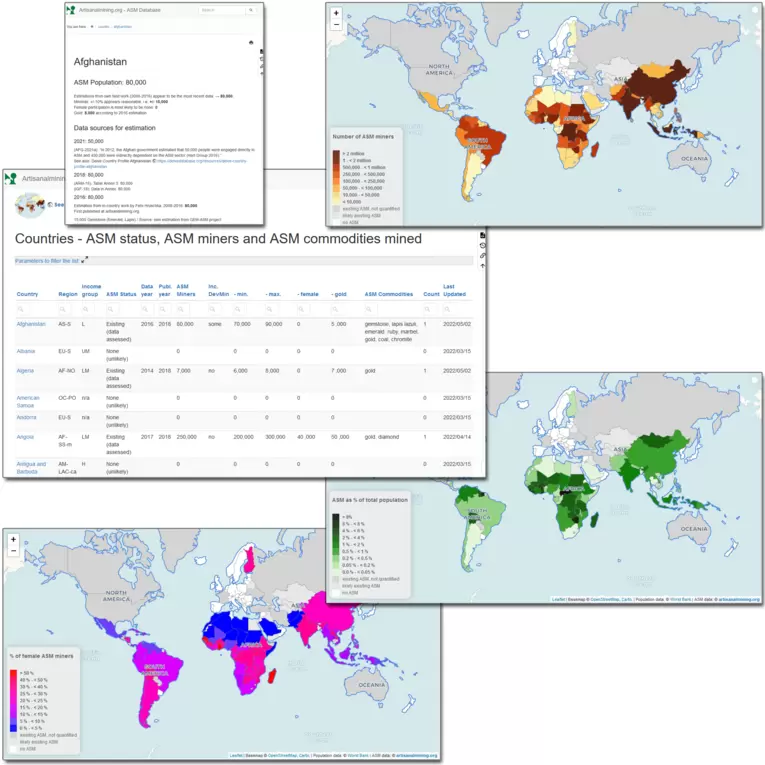
Current Data Summary
Quantitative data from 81 countries allow for an estimation of 49.0 million miners directly engaged in ASM (range: minimum 42.5, maximum 63.8 million).
- 26% of them (12.6 million) are women.
- 37% of them (17.9 million) are dedicated to gold mining (i.e. ASGM miners).
Evidence of ASM exists in 18 additional countries, where the ASM population has not been quantified. Additionally, in 19 countries it is most likely that ASM exists, but no documentation has been found so far. In total it is therefore estimated that ASM exists in 118 countries and ASGM in at least 88 countries.
Limitations and Outlook
Currently the database is populated with available data that had been collected over the past years. Due to resource limitations of an independent, self-funded, private initiative (as the entire artisanalmining.org website) no dedicated in-depth desk research nor in-country baseline studies were carried out.
But the database will be maintained as a living document and updated as soon as possible whenever new public information comes to my knowledge. There are also plans to add further analysis tools such as maps or dashboard graphics.
The database is intended as the author’s personal contribution to a better understanding of the importance of the ASM sector and expected to contribute to better public and corporate policies for the development of the millions of vulnerable ASM miners on the globe, who are still marginalized by most supply chains claiming to be “responsible.”
Comments