
Voices
09 August 2023
-
 planetGOLD Guyana Communications Consultant
INTRODUCTION
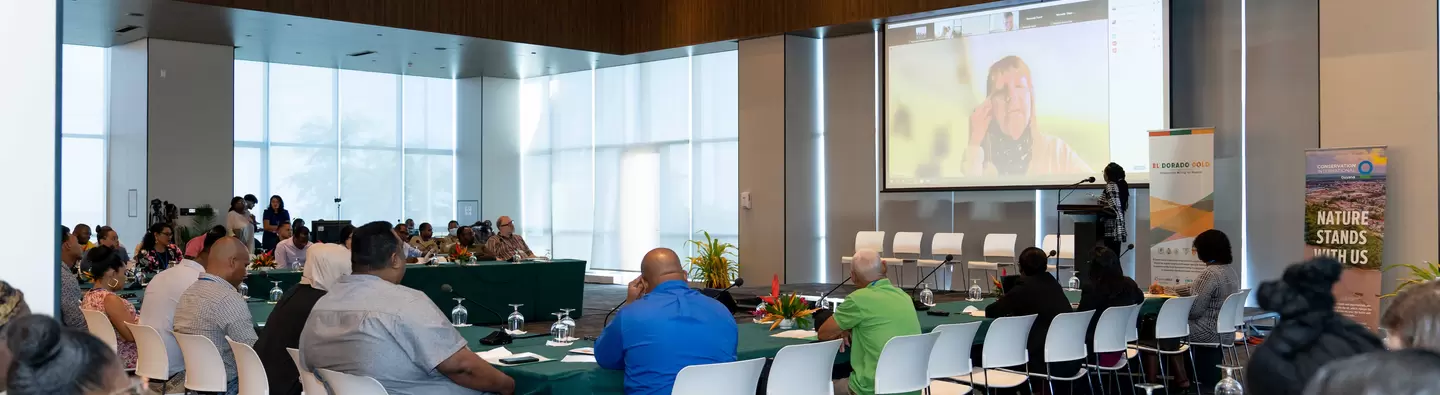
“His word was as good as gold” - one of, if not, the finest compliment that could be paid. And this saying comes to mind in reflecting on the Responsible Mining Conference, held on 18-20 January 2023, in Georgetown, Guyana under the theme Responsible Mining with Better Equipment Leading to Bigger Production. The Conference was a key activity of the Global Environment Facility-funded planetGOLD Guyana project, which is part of CI - Guyana’s Responsible Mining Initiative (RMI). It was organized by Conservation International (CI-Guyana) in partnership with the Ministry of Natural Resources (MNR), Guyana Geology and Mines Commission (GGMC), the National Toshao Council, Guyana Gold and Diamond Miners Association, planetGOLD Guyana and supported by GEF and the Norwegian Agency for Development Cooperation (NORAD).
The Conference held true to its objectives to:
(i) provide a platform for miners to engage with relevant state agencies, researchers and other stakeholders on modern innovations and trends in mining technologies and techniques; options for financial mechanisms and marketing of responsibly mined gold; and (ii) identify areas of achievement related to responsible mining and the existing gaps, as well as provide a forum for commitment to follow up as a partnership on future initiatives aligned with gaps identified.
Approximately 120 persons participated in a space that was both physical and virtual. They comprised artisanal, small and medium scale miners, academics, researchers, professionals, government (environment/natural resources health, labour) and other state agencies, training institutions in mining, leaders of Guyana’s indigenous communities, the private sector, and international organizations including the Global Environmental Facility and the World Wildlife Fund (WWF). Presenters and other participants in and out of the diaspora, including H.E. Mr. Samuel Hinds, Guyana’s Ambassador to the United States, joined the discourse that was informative and instructive, fair and frank, encouraging and empowering.
CONVERGING PERSPECTIVES
With converging perspectives, they shared, discussed, learned and committed to the broad and specific, along with national and international issues of responsible mining. CI-Guyana’s Technical Director, Rene Edwards said the conference was about taking stock from the work of the planetGOLD, Guyana, project, the private sector, academic institutions, government agencies and other NGO projects.
“It is pausing, reflecting, and thinking forward about how we could collaborate and work together to have a more responsible mining sector….” Susan Keane, Global Coordinator, planetGOLD Programme expressed the hope that Guyana will benefit from the work done under the project, and all other associated projects in the responsible mining initiatives remarking that the audience was part of a global conservation.
“I really want to make everyone aware that you’re all…part of a global conversation on the transition not only away from mercury, but towards a more responsible and profitable and cleaner and safer small- scale mining sector….” Curtis Bernard, Executive Director, CI-Guyana acknowledged the role of partnerships over the past decade, and expressed gratitude - “This conference is really about the power of partnership, and the real-world opportunities for practical innovations to shape a more responsible gold mining sector in Guyana. We are grateful for the partnerships that have been formed and strengthened over the past decade and to continuing this work.
THE BROAD ISSUES
It was in this light that the myriad perspectives shared, discussed and even sometimes debated fell under the broad sub-themes: developing and maintaining growth; safeguarding the environment; occupational health, safety and social inclusion; prospecting for gold; mercury reduction techniques and partnerships. The presentations, panel and plenary discussions considered challenges, opportunities, recommendations and commitments regarding:
- financing and technology and the barriers to be overcome in the sector;
- increasing recovery through better technology;
- formalization of mining for environmental and social responsibility;
- dangers of mercury use to human health and the environment
- importance of and potential benefits from prospecting; and
- partnerships as an important vehicle to sustain the gains and to move forward.
So, what were among the key takeaways?
It was understood and accepted that successful transition to mercury-free mining specifically, and a more responsible mining sector, generally, was possible, but needed financing for employing new technology, acceptance of social environmental responsibility and a culture of collaboration and partnerships. In this light, the following were considered .
Financing and technology and the barriers to be overcome
Financing:
- Getting the best returns by prospecting and mining in areas that have commercially viable deposits and increasing the efficiency of production through appropriate equipment, including new technologies and techniques that are inexpensive, for example, modification of sluice boxes.
- Responding to financial challenges in the sector by inter alia, correcting the lack of financial knowledge of miners through capacity building, on how to seek loans, improving record keeping for better financial management. Educating financial institutions about mining (for example, understanding that ASGM mining is extremely diverse (in needs, abilities to repay, sophistication of operations and management) and therefore financing requires a suite of solutions;
- Providing financial and technical support for the transition - before, during, and after the adoption of mercury-free process, for example, during training, and downtime when the equipment is being moved or just beginning to be used.
- Understanding that the financial pathways to accessing technology is not only through government and that finance is available and working well through informal channels., given the productivity of the sector. Orient the financial institutions to appreciate the benefits in financing and responsible mining, and not just mining and production. Engage and support suppliers as a category of lenders; they already have systems in place.
Technology
- Knowing what it takes to move from mercury to mercury-free processing by understanding the gold. How fine or how coarse it is. GGMC provides testing and the results facilitates choosing the appropriate technology. Miners can seek this assistance and do a cost-benefit analysis to understand whether the investment in those technologies is really warranted. Take “baby” steps towards transitioning.
- Improving the technology used by facilitating mercury-free mining with impactful technology that is affordable, acceptable, and environmentally simple, thus promoting adoption to new practices.
- There are technologies that help to clean gold concentrate from the sluice box that are below US$1,000. These can be incorporated into the existing sluice box operations without adding anything else and that could result in an inexpensive transition to mercury free.
- Better technology increases recovery which is a better way to increase gold production than increasing throughput. Processing gold in a way that avoids the liability of significant amounts of gold being left in tailings.
- Exploring training options from suppliers of equipment.
Formalization of mining for environmental and social responsibility
- Mainstreaming environmental and social responsibility in projects and plans.
- Developing and implementing environmentally measurable plans as priorities. This includes identifying and replicating best practices and success stories; complying with the Bureau of Standards that applies criteria for the production of mercury-free gold, including obligations under the UN Convention on the Rights of the Child; mining rehabilitation and sound relationships with indigenous communities.
- Plan, budget, monitor, especially partner to effect changes in the mining process and in miners’ behaviour. Work collaboratively with the GGMC, Ministries (security, health, labour) and community leaders, particularly from indigenous communities, to develop and implement preventative measures; create awareness, monitor, and incentivize.
- Respecting environmental rights and rights of women to access land, finance and technology and enforcing policy/law to ensure that large-scale miners assist with development of the community, in keeping with the Amerindian Act.
- Understanding the link between production safety and personal safety to prevent fatalities (mining fatality is one of the highest compared to the other sectors) preventing the worst form of labour, evidenced by children selling sex; and improving security in the back dams.
- Addressing the stigma attached to mining by documenting the positive stories and telling them on appropriate and effective communications platforms.
- Maintain good health; occupational health should be a priority.
- Good tailings management as improved environmental management.
Partnerships
In summing up the discourse on fostering a culture of partnership, roles and responsibilities of organizations were shared, barriers and challenges highlighted and discussed, recommendations made and commitments to future partnership expressed. Whether articulated as any of the foregoing, the undisputed conclusion was, those partnerships, public and private, national and international were the bedrock for true development of the environment for current and future generations and was not possible without genuine collaboration. There was unison in the voices that as individuals and Guyanese, partnerships were important, are important and will continue to be important, as captured by the following voices.
- EPA: Our challenge is misaligned priorities which lead to an overburden or transaction cost on the agency. These things must be considered, as they are critical.
- CI-Guyana: For this RMI, we have worked to identify where opportunities as well as challenges are, using funding sources for focusing on lasting change, rather than the discrete projects. We will continue to bring an approach that is solution-oriented; finding ways to facilitate constructive conversations, building collaboration around wider change, keeping the focus on the bigger picture.
- WWF: We have been working with miners and collaborating with the University of Guyana (UoG) to share the impact of mercury.
- MNR: As the policy advising body for the extractive sector, forestry and mining, we will continue to create an enabling environment with our partners’ support.
- GGDMA: The mining sector has relied on the GGDMA, GWMO and the National Mining Syndicate and are party with these associations. At the same time, the associations have partnered with the government and with the UoG with respect to miners’ obligations and have passed that on to miners. Looking for support for the mining sector as a whole, the GGMC has stepped forward with a more robust technical assistance programme to support the environmental and social obligations process. Disparity and cost considerations are barriers and we struggle with these issues; we assume that miners are making a lot of money and are supposed to take care of this issue
- Toshao. Understanding what our role and responsibilities are with regard to the environment, the mining regulations to be followed and how we could assist persons within our villages and communities. Unawareness of the opportunities and services remains a barrier.
- GGMC: Communication has been a major barrier for us. Many miners don’t know of our services, but having a partnership with miners onboard provides a remedy for this…. a partnership lends credibility.
The essence of their recommendations towards chartering a course for better harmonization of efforts to build on what was already in place and with mutually assured benefits are also captured.
EPA: Pool resources. Going forward as the GEF focal point, we have US$8 million of which 50% is for biodiversity.
CI- Guyana: De-risk operations, by trying to provide the conditions in which there is a bit more certainty.
WWF: Support continuous engagement by coordinating efforts around the Working Group.
MNR: Reactivate the national working groups. The articles of the Minamata Convention speak to reporting. We will have to reconvene the national working group to report on our progress. The political will is there.
GGDMA: Develop a profile of what the environmental and social obligations are in each of the existing 1500 mining operations. Put more booths on the ground for data collection and community outreach. Define the partnership by documenting and demonstrating what works.
GEF: Financing for miners to acquire the necessary equipment. Financing on the ground. Speak to GEF about enabling support.
CONCLUSION
I’m reminded of the advice “when you lead, make your leadership a gold mining process and not lead extraction”. Paradoxically, though considered core, “lead” (gold) extraction was just one of a multitude of issues addressed, as I thought of the two and half days of sharing on modern innovations and trends in mining technologies and techniques, options for financial mechanisms, social and environmental responsibilities and marketing of responsibly mined gold and leading the way towards a responsible mining sector. It was a responsible mining exploration, complete with the required leadership for engaging, enlightening and enjoying; for instructing and impacting. The conference held true to its objectives and the impact of partnership was felt … In the short and simple, but profound words of Ingrid Sarabo, Director of planetGOLD, Guyana, in giving the Vote of Thanks, “our work is nothing without you”.
Of note, is the justifiable caution by Professor Adam Kiefer that the adoption of mercury free technology is going to take time and patience and will require sector- wide support across many other sectors as well as partnerships. However, doing so is well worth the time. We consider the assurances of the Minister of Natural Resources, Hon. Vickram Bharrat in his keynote address on the importance of this sector as a significant contributor to Guyana’s development and “the need to keep the mining sector viable …/ and to ensure especially that small and medium- scale miners remain in mining, and mining remains profitable”.
“You have a partner in the Government of Guyana, in the Ministry of Natural Resources, you have a partner. You have an extended arm for us to work together in bettering the mining sector and ensuring that mining becomes sustainable while remaining profitable.”
This issue of sustainability and profitability in mining was underscored by all, whether it was from: environmental, occupational health and safety, and economics, perspectives or mercury phase-out, prospecting technology,or other perspectives. It was, however, the clarion call for partnerships for a more responsible mining sector which impacted the most. And this blog fittingly ends with the essence of this call, as captured in some voices -
- the social duty of care for the environment relates to all. We have a common interest.
- we are on the same boat to find ways to deal with the issues in the mining sector.
- it's important to bring and pull those ideals, interests, skills and everything together to achieve something that you're expecting and pooling resources to achieve it.
- True partnerships really work when you bring something to the table. The mining industry is already bringing thousands of jobs for Guyanese.
- We are seeing the benefits of working together in achieving our personal or organizational goals.
- Sharing the costs help satisfy some obligations with respect to social and environmental issues.
- Fostering partnerships that would help satisfy environmental and social obligations together with financial or economic gain and governance.
- So, we need partners, not only the ministries, but CI and other agencies that would be willing to come on board with us so that we can have mining done in a responsible manner.
And in testimonials of some miners:
“I've been doing mining all the years the regular way and now we get the new equipment coming out and we want to eliminate. The equipment very good, you getting a lot of recovery. Obviously, the old style, you get 50% recovery and with the new technology you now getting like 25 to 30% more. It is profitable for our miners…with the new technology, you're doing the same work, but you getting more production… and you don’t use the mercury…”. - Bernard Alphonso, Concessionaire, Region 8
“The system works. I had the opportunity to experience it. He recovered all of the gold in the gold kacha. It was impressive. I would encourage small miners to access the new technology and the financing. Form groups in these areas so that other small miners could see”. - Nicola Trotz, Miner Region 7
“I lost my husband in 2014 due to mercury. I would encourage people if you could afford to work and eliminate the use of mercury, it could save our lives. We could work for a long time…. Doing the necessary safety measures, it would work for us. I was excited about the Gold Cube; it is a big equipment for a small miner. Why not try to reach out to more miners. Give them the opportunity to have one. Teach them to work how to use it. Give them the full training how to use it”.- Nicola Trotz, Miner Region 7
Countries: